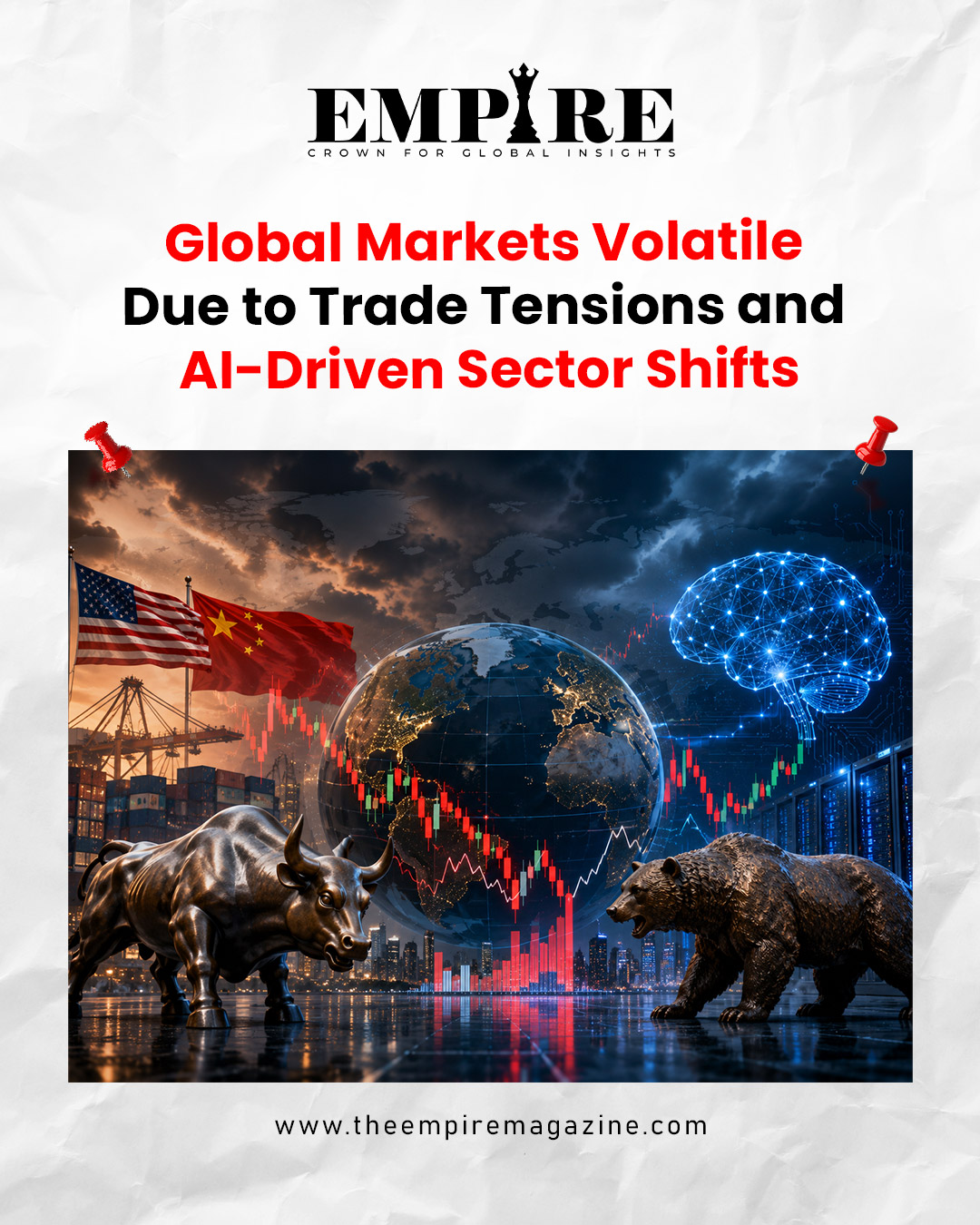
Global markets volatile as trade tensions, AI-driven sector shifts, and economic uncertainty reshape investor confidence and global investment strategies. Global markets are volatile as rising trade tensions, AI-driven sector shifts, and changing monetary policies reshape investment strategies worldwide. While technology and artificial intelligence continue to attract capital, geopolitical uncertainty and tariff disputes are creating fresh challenges for businesses, investors, and policymakers across global financial markets.
Global Markets Volatile as Trade Tensions and AI Sector Shifts Reshape Investor Confidence
Global financial markets are once again entering a period of uncertainty. Investors who began the year with optimism are now navigating an increasingly complex environment where geopolitical tensions, evolving trade policies, inflation concerns, and the rapid rise of artificial intelligence are influencing every major investment decision. From Wall Street to Asian exchanges and European markets, volatility has returned as businesses attempt to balance growth opportunities with rising economic risks.
While technology companies continue attracting unprecedented investments because of artificial intelligence, traditional sectors are facing fresh challenges arising from changing global supply chains, tariffs, and slowing international trade. The contrast between soaring AI-driven businesses and struggling manufacturing industries has created one of the widest sectoral divergences witnessed in recent years. As governments continue reshaping economic policies to protect domestic industries while competing for technological leadership, investors are reassessing long-term strategies.
Financial experts believe today’s uncertainty differs significantly from previous market cycles. Instead of a single economic event driving volatility, multiple structural changes are unfolding simultaneously. Artificial intelligence is transforming corporate profitability, governments are redesigning trade relationships, central banks remain cautious about inflation, and businesses are adapting to a rapidly changing global landscape. Together, these forces are redefining how capital flows across industries and international markets.
For companies, the current environment demands greater resilience. For investors, it requires disciplined decision-making. And for policymakers, it presents the difficult challenge of encouraging innovation without disrupting global economic stability.
Why Global Markets Volatile Trends Are Returning
The reason global markets volatile conditions have resurfaced lies in the convergence of several powerful economic forces rather than one isolated event. International trade disputes have intensified across major economies as governments introduce new tariffs, export restrictions, and industrial policies aimed at strengthening domestic manufacturing while reducing dependence on foreign supply chains. At the same time, businesses continue adjusting to post-pandemic supply networks, rising labour costs, and higher borrowing expenses, all of which have increased uncertainty across global financial markets. Investors are also responding to mixed economic data, where resilient employment figures coexist with slowing manufacturing activity and uneven consumer spending, creating conflicting signals about future economic growth.
Adding to this complexity is the extraordinary pace of artificial intelligence adoption. Companies that demonstrate strong AI capabilities continue attracting significant investor attention, while businesses that have yet to establish a clear AI strategy are increasingly viewed as lagging behind competitors. This has widened the performance gap between sectors, with technology stocks often outperforming industrial, retail, and export-oriented businesses. As a result, portfolio allocations are changing rapidly, contributing further to fluctuations in equity valuations. The combination of trade tensions, AI investment enthusiasm, and evolving monetary policies has created an environment where daily market movements increasingly reflect long-term structural transformation rather than temporary speculation.
Global Markets Volatile as Trade Tensions Intensify
Trade tensions have once again become one of the biggest drivers behind why global markets volatile conditions continue dominating financial headlines. Several economies have introduced new tariffs, export controls, and restrictions on strategic technologies, particularly in industries involving semiconductors, critical minerals, renewable energy equipment, and advanced manufacturing. Businesses operating across multiple countries are facing increasing compliance costs while reassessing sourcing strategies to reduce geopolitical risks. This shift has encouraged companies to diversify production facilities, relocate manufacturing operations, and build more resilient regional supply chains, but these transitions require substantial capital investments and time.
For multinational corporations, uncertainty surrounding international trade agreements complicates long-term planning and capital allocation decisions. Investors closely monitor every policy announcement because changes in tariffs or export restrictions can immediately influence corporate earnings expectations. Industries such as automotive manufacturing, consumer electronics, industrial machinery, logistics, and commodities remain particularly sensitive to these developments. Currency markets have also experienced greater fluctuations as governments attempt to balance export competitiveness with domestic inflation management. Collectively, these evolving trade dynamics are reinforcing market volatility while encouraging investors to prioritise companies with diversified operations, stronger balance sheets, and greater geographic flexibility.
AI Sector Shifts Are Changing Investment Priorities
Artificial intelligence has become one of the most influential themes shaping why global markets volatile behaviour increasingly reflects sector-specific performance rather than broad market movements. Investment flows continue concentrating in businesses developing AI infrastructure, cloud computing platforms, semiconductor technologies, cybersecurity solutions, and enterprise software capable of integrating intelligent automation. Companies successfully incorporating AI into products, operations, and customer experiences are reporting improved productivity, stronger revenue expectations, and greater investor confidence, leading to substantial gains in market valuation.
However, this transformation has also created considerable imbalance across industries. Traditional sectors such as manufacturing, banking, retail, energy, and transportation are under growing pressure to modernise their operations while managing the significant costs associated with AI implementation. Businesses that delay digital transformation risk losing competitiveness as automation increasingly improves efficiency and reduces operational expenses. Investors are therefore distinguishing between organisations actively investing in technological innovation and those perceived as slow to adapt. This widening gap between AI leaders and conventional businesses explains why equity markets frequently experience sharp sector rotations even when broader economic conditions remain relatively stable. The AI revolution is no longer a future possibility, it has become a defining factor influencing capital allocation worldwide.
Global Markets Volatile Across Different Industries
The impact of global markets volatile conditions varies considerably across industries because each sector responds differently to economic uncertainty, technological disruption, and geopolitical developments. Technology companies continue benefiting from strong demand for AI solutions, cloud services, and advanced computing infrastructure, whereas export-driven manufacturers face pressure from tariffs, supply chain disruptions, and fluctuating commodity prices. Energy markets remain influenced by geopolitical conflicts, production decisions, and changing demand expectations, while financial institutions carefully monitor interest rate movements and credit quality.
Consumer-focused businesses are also experiencing changing spending patterns as households balance inflation, borrowing costs, and employment prospects. Luxury brands continue demonstrating resilience among affluent consumers, whereas mass-market retailers are increasingly focusing on affordability and value-driven offerings. Healthcare companies, meanwhile, are benefiting from continued investment in biotechnology, digital health, and pharmaceutical innovation despite broader market fluctuations. These contrasting sector performances illustrate why investors are moving beyond traditional diversification strategies and placing greater emphasis on identifying structural growth opportunities. Rather than reacting solely to macroeconomic indicators, markets are increasingly rewarding companies capable of combining operational resilience with technological innovation and sustainable long-term business models.
Central Banks Face New Economic Challenges
Central banks have entered one of their most complex policy environments in decades as global markets volatile conditions continue challenging monetary decision-making. Inflation has moderated compared to previous peaks but remains above long-term targets in several economies, preventing policymakers from rapidly reducing interest rates. At the same time, slowing economic growth, geopolitical uncertainty, and weakening global trade require measures that support business investment without reigniting inflationary pressures. Every interest rate decision is therefore closely analysed by investors seeking clues about future borrowing costs, corporate profitability, and consumer demand.
Higher financing costs continue affecting commercial real estate, infrastructure projects, startup funding, and capital-intensive industries, while technology firms with stronger cash reserves remain relatively insulated. Financial markets often react sharply to central bank communications because even subtle changes in policy language can influence expectations surrounding future economic conditions. Governments are simultaneously expanding industrial policies to strengthen strategic sectors including semiconductor manufacturing, renewable energy, defence technology, and artificial intelligence infrastructure. The interaction between fiscal policy, monetary policy, and technological transformation is creating an investment environment unlike previous economic cycles, where long-term structural trends increasingly outweigh short-term market sentiment.
Businesses Adapt to a New Investment Reality
Corporate leaders increasingly recognise that surviving global markets volatile conditions requires more than financial discipline; it demands strategic agility. Organisations across industries are investing heavily in digital transformation, cybersecurity, supply chain diversification, workforce reskilling, and artificial intelligence integration to improve operational resilience. Rather than focusing exclusively on cost reduction, businesses are prioritising innovation capable of generating sustainable competitive advantages over the coming decade. Investors are rewarding companies demonstrating clear long-term strategies while penalising those that fail to communicate how they intend to navigate technological disruption and geopolitical uncertainty.
Environmental, social, and governance priorities also continue influencing capital allocation decisions, although profitability and technological competitiveness have regained greater importance amid current market conditions. Companies capable of balancing responsible business practices with innovation and financial performance are attracting broader investor confidence. Private equity firms, sovereign wealth funds, and institutional investors increasingly favour businesses positioned to benefit from AI adoption while maintaining diversified global operations. This shift reflects a broader transformation in investment philosophy, where resilience, adaptability, and technological leadership have become equally important measures of corporate value.
The Road Ahead for Global Markets
The future of global markets volatile conditions will largely depend on how governments manage trade relationships, how quickly businesses adopt artificial intelligence, and whether central banks successfully balance inflation control with economic growth. Although uncertainty is likely to persist in the near term, periods of volatility have historically created opportunities for companies capable of adapting faster than competitors. Businesses investing in innovation, operational flexibility, and resilient supply chains are expected to emerge stronger as the global economy enters its next phase of transformation.
For investors, the current landscape reinforces the importance of disciplined, long-term thinking rather than reacting to short-term market swings. Artificial intelligence will continue reshaping industries, while geopolitical developments will influence global trade and capital flows for years to come. Success will increasingly belong to organisations that embrace change rather than resist it. As technological progress accelerates and economic policies evolve, the world’s financial markets are entering an era where resilience, innovation, and strategic foresight will define sustainable growth. Although uncertainty remains unavoidable, it also serves as the catalyst for the next generation of global business leadership and investment opportunities.
Story behind global markets volatile
The story behind global markets volatile conditions is no longer simply about fluctuating stock prices. It reflects a deeper transformation taking place across the global economy, where artificial intelligence, geopolitical competition, evolving trade relationships, and changing investment priorities are simultaneously reshaping the business landscape. Companies that innovate responsibly, diversify strategically, and adapt quickly will be better positioned to navigate future uncertainty, while investors who remain focused on long-term fundamentals rather than short-term headlines are likely to benefit from the opportunities emerging within this new economic era.
For more business and retail insights, read more on The Empire Magazine
Previous article: https://theempiremagazine.com/india-startup-growth/
Magazine Feautures | Podcasts: Empire Global Talks
Follow The Empire Magazine on Facebook | Instagram | LinkedIn | YouTube
The Empire Magazine | Crown for Global Insights