
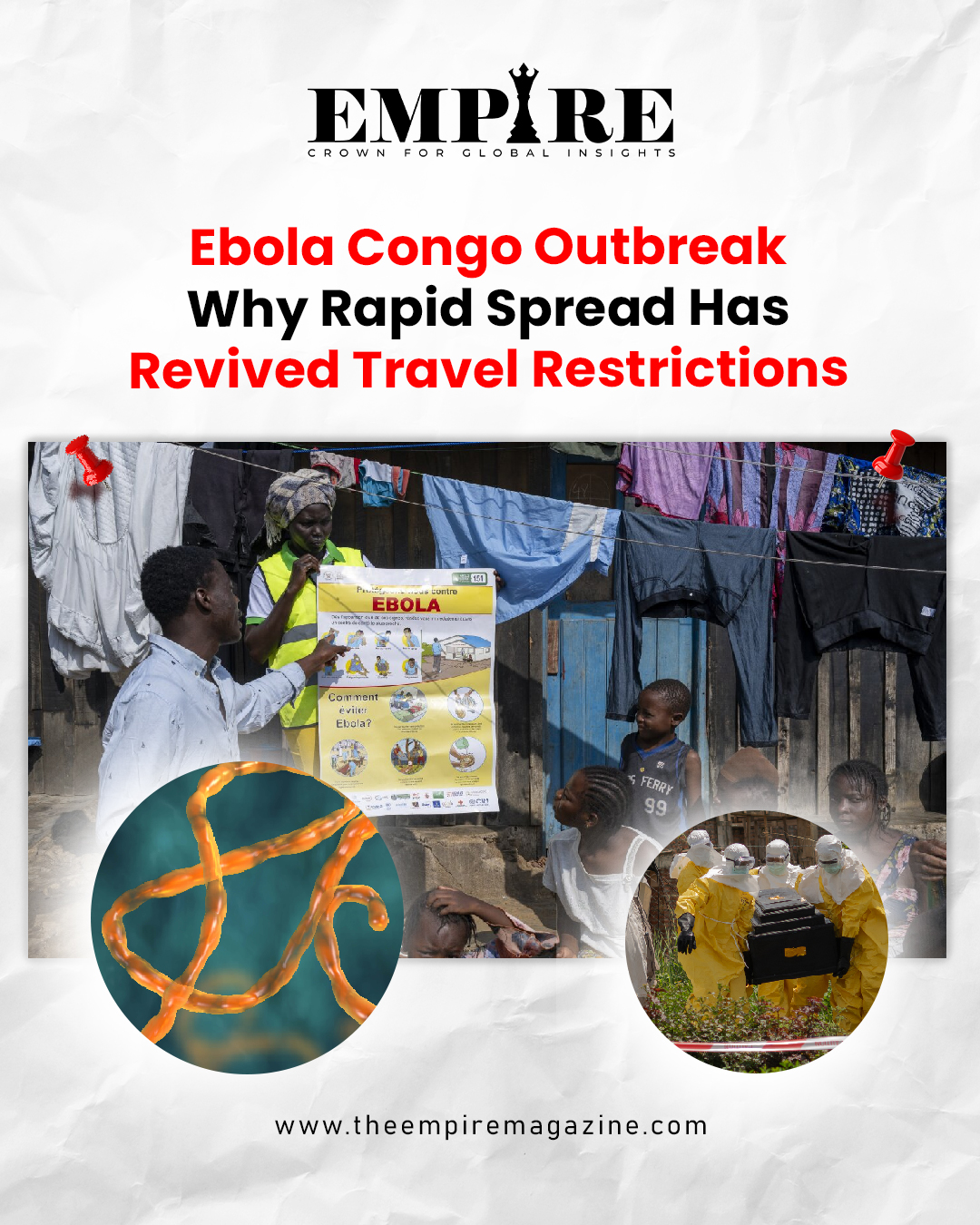
Ebola Congo Outbreak has become a major public health concern as the Democratic Republic of Congo faces a fast-growing Ebola crisis that has already killed more than 100 people and spread across conflict-affected areas. The outbreak involves the Bundibugyo strain of the Ebola virus and has created alarm across Central Africa and beyond.
The outbreak was officially declared in May 2026, but health officials believe the virus may have been spreading earlier before being fully detected. This delay has made the response more difficult because Ebola can spread quickly through close contact with infected people, contaminated bodily fluids, unsafe burials, and weak infection-control systems.
The situation has also revived travel restrictions, border measures, and airport screening in several countries. While health experts warn that blanket travel bans can disrupt response efforts, governments are under pressure to protect borders, reduce importation risk, and reassure the public.
Ebola Congo Outbreak and the Current Situation
Ebola Congo Outbreak has become serious because confirmed cases and deaths have risen quickly. The outbreak is concentrated mainly in eastern Congo, especially Ituri province, while cases have also been reported in North Kivu and South Kivu. These provinces already face insecurity, displacement, weak health infrastructure, and access challenges.
The Bundibugyo strain is one of the known Ebola virus species. It is less common than the Zaire strain, which caused several previous large outbreaks. One challenge with the current outbreak is that there is no widely approved vaccine specifically for the Bundibugyo strain, making rapid detection, isolation, contact tracing, safe burials, and community trust even more important.
The outbreak has also crossed into Uganda, where confirmed cases have been reported among people linked to cross-border movement. This has increased regional concern because communities near the Congo-Uganda border often travel for trade, family, work, healthcare, and daily needs.
Why Ebola Is Spreading Rapidly in Congo
Ebola is spreading rapidly in Congo because several risk factors are happening at the same time. The first is delayed detection. If an outbreak spreads for weeks before being identified, many people may already have been exposed by the time health teams begin tracing contacts.
The second factor is conflict. Armed groups operate in parts of Ituri, North Kivu, and South Kivu. Violence can block health workers from reaching affected communities, disrupt burial teams, limit laboratory testing, and make it harder to isolate patients safely.
The third factor is community mistrust. In past Ebola outbreaks, misinformation and fear have made some communities suspicious of health workers. If people hide symptoms, avoid treatment centers, or reject safe burial practices, the virus can continue spreading.
Conflict and Health Response Challenges
Conflict makes Ebola response much harder. Health workers need secure access to identify cases, trace contacts, transport patients, run laboratories, and educate communities. If roads are unsafe or teams are attacked, response efforts slow down.
Reports from affected areas have described attacks on response teams and restrictions caused by armed groups. This is dangerous because Ebola control depends on speed. Every missed contact or delayed burial can create new chains of transmission.
Eastern Congo has faced years of instability, which means many communities are already dealing with displacement, poverty, limited healthcare, and low trust in institutions. This creates a difficult environment for emergency health teams.
Why Travel Restrictions Have Returned
Travel restrictions have returned because governments fear cross-border spread. Some countries have increased screening at airports and land borders, while others have introduced entry restrictions or advisories for travelers from affected regions.
Uganda temporarily closed part of its border with Congo in response to the outbreak. Other countries have introduced screening or restrictions for travelers who recently visited affected countries. Airlines have also faced operational issues because of entry measures affecting crew and passengers.
However, the World Health Organization has warned that blanket travel restrictions are often ineffective and can make outbreak response more difficult. If travel bans disrupt medical supplies, humanitarian workers, laboratory materials, or emergency response teams, they can slow containment efforts.
Screening Versus Blanket Travel Bans
There is an important difference between targeted screening and broad travel bans. Screening measures may include temperature checks, health questionnaires, monitoring of travelers from affected areas, and rapid referral of suspected cases. These measures can help identify risk without completely blocking movement.
Blanket travel bans are more controversial. They may appear strong politically, but they can discourage people from reporting symptoms or crossing through official points where screening exists. They can also damage trade, family movement, and humanitarian access.
For Ebola, experts usually emphasize contact tracing, isolation, infection control, safe burials, community engagement, and targeted monitoring over broad travel shutdowns.
What the Outbreak Means for Neighboring Countries
Neighboring countries are on alert because Ebola does not respect borders. Congo shares long land borders with countries including Uganda, Rwanda, Burundi, South Sudan, Tanzania, Zambia, Angola, the Central African Republic, and the Republic of Congo.
Cross-border trade and family movement are common in the region. People may travel for markets, healthcare, religious events, funerals, and work. This makes border preparedness essential.
Uganda has already reported cases linked to the outbreak. Other countries have increased surveillance, prepared screening protocols, and strengthened health-system readiness. The goal is to detect any imported case quickly before it creates local spread.
WHO and Africa CDC Response Plan
The World Health Organization and Africa CDC have launched a joint continental response plan to support outbreak control and regional preparedness. The plan aims to raise $518 million for detection, response, treatment, surveillance, laboratory support, risk communication, and preparedness across affected and at-risk countries.
This response is important because Ebola containment requires coordination. Congo alone cannot manage the outbreak if the virus continues spreading across borders. Regional cooperation is needed for surveillance, data sharing, border health, supplies, and medical support.
International support is also necessary because the affected areas are already under pressure from conflict and weak infrastructure. Without enough funding, health teams may struggle to scale testing, treatment, contact tracing, and community outreach.
Why Contact Tracing Matters
Contact tracing is one of the most important tools in Ebola control. Health workers identify people who had contact with confirmed cases and monitor them for symptoms. If they become sick, they can be isolated quickly before infecting others.
The challenge is that contact tracing requires trust and access. People must be willing to share names, movement history, and exposure details. In insecure areas, health teams may not be able to reach every contact.
When contact tracing is incomplete, the virus can continue spreading silently. This is why community engagement is as important as medical treatment.
Symptoms and Transmission Risks
Ebola symptoms can include fever, weakness, muscle pain, headache, sore throat, vomiting, diarrhea, rash, and in some cases bleeding. Symptoms can look like other illnesses at first, which makes early detection difficult in areas where malaria, typhoid, and other infections are common.
Ebola spreads through direct contact with bodily fluids of infected people or contaminated materials. It can also spread during unsafe burial practices if mourners touch the body of someone who died from Ebola.
Healthcare settings are high-risk if infection control is weak. Health workers need protective equipment, training, isolation facilities, and safe waste management to reduce transmission.
Why Public Trust Is Critical
Public trust is critical because Ebola response depends on community cooperation. People must feel safe reporting symptoms, going to treatment centers, allowing safe burials, and sharing contact information.
If communities believe Ebola is fake, political, or linked to outside interests, they may resist response teams. This has happened in past outbreaks and can make the virus harder to control.
Local leaders, religious figures, community health workers, and survivors can help build trust. Clear communication in local languages is essential. People need to understand how Ebola spreads, why isolation matters, and how treatment can improve survival chances.
Treatment and Supportive Care
There is no simple cure for all Ebola strains, but early medical care can improve survival. Supportive care may include fluids, oxygen, symptom management, treatment for other infections, and careful monitoring.
For some Ebola species, specific treatments and vaccines exist. However, the Bundibugyo strain creates additional challenges because vaccine and treatment options are more limited than for the Zaire strain.
This makes early detection and prevention even more important. Stopping transmission is the fastest way to reduce deaths.
Business and Travel Impact
The Ebola outbreak also has business and travel consequences. Travel restrictions can affect airlines, trade routes, tourism, sports, humanitarian missions, and cross-border commerce. Companies operating in affected regions may need to review employee safety, medical evacuation plans, travel policies, and supply chains.
Border closures and screening delays can disrupt normal movement. At the same time, uncontrolled spread would be even more damaging. Governments and businesses therefore need balanced policies that protect health without blocking essential response work.
For travelers, the most important step is to follow official health advisories and avoid unnecessary travel to affected zones when advised. Businesses should monitor updates from health authorities and prepare contingency plans for staff working in the region.
Why This Outbreak Matters Globally
Ebola Congo Outbreak matters globally because infectious disease threats can move beyond one region if not contained quickly. Even when the risk to distant countries is low, global health systems pay attention because early containment is much easier than late response.
The Covid pandemic showed how important preparedness, surveillance, and public trust are. Ebola is different from Covid because it does not spread as easily through the air, but it is far deadlier and can overwhelm local health systems if response breaks down.
The current outbreak is a reminder that global health security depends on strong local systems. Laboratories, clinics, trained health workers, safe burial teams, vaccines, treatments, and community trust are all part of outbreak control.
What Happens Next in Congo
The next stage will depend on whether health teams can slow transmission in Ituri, North Kivu, and South Kivu while preventing further regional spread. Key tasks include expanding testing, improving contact tracing, protecting health workers, supporting treatment centers, increasing community engagement, and keeping essential travel and supply routes open.
Travel restrictions may continue or change depending on case numbers and regional risk. However, health experts are likely to keep pushing for targeted, evidence-based measures rather than broad bans that disrupt response operations.
The outbreak remains dangerous, but rapid funding, regional coordination, and community cooperation can still reduce transmission. Ebola control depends on speed, trust, and access, especially in conflict-affected areas where the virus can exploit every gap in the health system.
Readers can also explore more immigration and policy insights through this related article: H-1B Visa Fee Blocked: What the $100,000 Ruling Means for Indians.
For more updates from The Empire Magazine, follow us on Facebook and Instagram.
– The Empire Magazine
Crown For Global Insights