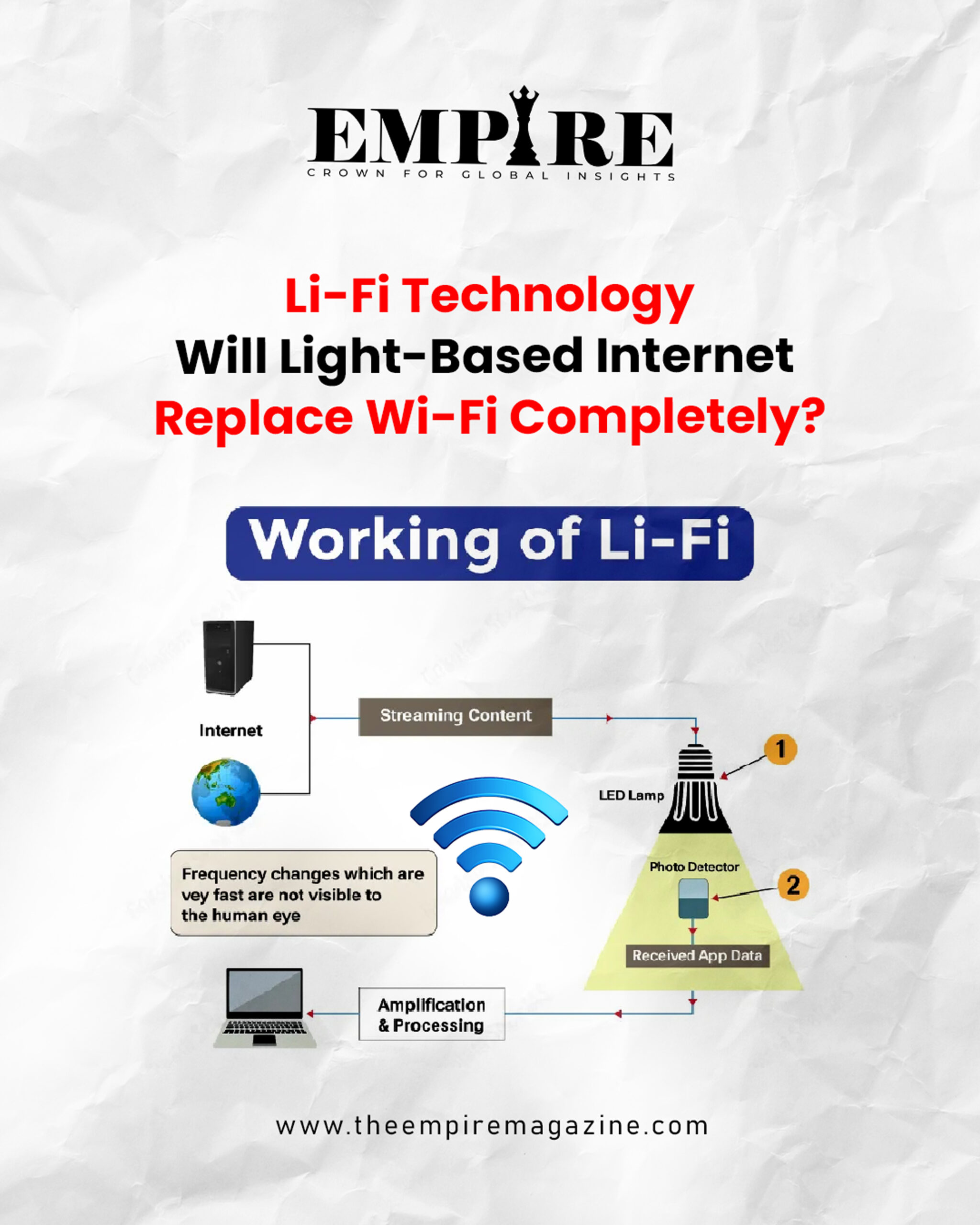
Li-Fi Technology is emerging as one of the most promising innovations in wireless communication, using light instead of radio waves to transmit data at incredibly high speeds. As the world demands faster, more secure, and more efficient connectivity, many experts are asking whether Li-Fi will eventually replace Wi-Fi entirely.
What is Li-Fi Technology?
Li-Fi, short for Light Fidelity, is a wireless communication technology that uses visible light, infrared, or ultraviolet spectrum to transmit data. It was first introduced by Professor Harald Haas of the University of Edinburgh in 2011. Unlike traditional Wi-Fi, which uses radio frequency (RF) waves, Li-Fi utilizes LED bulbs to send and receive data through rapid flickering of light — a process invisible to the human eye.
In simple terms, when you switch on a Li-Fi-enabled LED light, it can transmit data while also providing illumination.
How Li-Fi Works
Li-Fi operates on a very basic principle:
- A LED light source acts as a transmitter.
- Data is encoded into rapid changes in light intensity.
- A photodetector (receiver) converts these light fluctuations back into electrical signals.
Because light cannot pass through walls, Li-Fi signals are naturally confined to a specific room, making it inherently more secure than Wi-Fi.
Key Advantages of Li-Fi Technology
Li-Fi offers several significant benefits over traditional Wi-Fi:
- Extremely High Speed: Li-Fi can theoretically reach speeds up to 100 Gbps, far surpassing current Wi-Fi standards.
- No Interference: Since it uses light, Li-Fi does not interfere with radio waves, making it ideal for environments like hospitals, aircraft, and industrial plants.
- Enhanced Security: Light cannot penetrate walls, reducing the risk of hacking from outside.
- Energy Efficiency: It uses existing LED lighting infrastructure, potentially lowering overall energy consumption.
- Unlimited Spectrum: Visible light spectrum is 10,000 times larger than the radio spectrum, solving bandwidth congestion issues.
- Low Latency: Ideal for applications requiring real-time communication like autonomous vehicles and remote surgery.
Current Limitations of Li-Fi
Despite its advantages, Li-Fi still faces several practical challenges:
- Limited Range: Light cannot travel through obstacles, so coverage is restricted to line-of-sight areas.
- Infrastructure Requirement: Every room needs Li-Fi-enabled lights and receivers.
- Uplink Challenge: While downlink (downloading) is strong, uploading data remains relatively weaker.
- Sunlight Interference: Performance can drop in brightly lit outdoor environments.
- Maturity: The technology is still in the early commercialization stage compared to mature Wi-Fi systems.
Li-Fi vs Wi-Fi: A Detailed Comparison
| Feature | Li-Fi Technology | Wi-Fi Technology | Winner |
|---|---|---|---|
| Speed | Up to 100 Gbps | Up to 10 Gbps (Wi-Fi 7) | Li-Fi |
| Security | Very High (Light-based) | Moderate | Li-Fi |
| Range | Short (Room-level) | Long (Building-wide) | Wi-Fi |
| Interference | None with radio waves | High in crowded areas | Li-Fi |
| Coverage | Line-of-sight only | Through walls | Wi-Fi |
| Cost of Deployment | Higher initially | Lower | Wi-Fi |
| Energy Efficiency | High | Moderate | Li-Fi |
Current Status in 2026
As of 2026, Li-Fi is moving from laboratory experiments to real-world deployments:
- Several companies in Europe, Japan, and the US have started commercial Li-Fi installations in hospitals, schools, and conference centers.
- The Indian government has shown interest in Li-Fi for defence and secure communication applications.
- Major LED manufacturers are integrating Li-Fi capabilities into smart lighting systems.
- Hybrid Li-Fi + Wi-Fi solutions are gaining traction, where Li-Fi handles high-speed, secure tasks while Wi-Fi provides broader coverage.
Will Li-Fi Replace Wi-Fi Completely?
The short answer is No — at least not in the near future. Instead of complete replacement, experts predict a hybrid future where Li-Fi and Wi-Fi coexist:
- Li-Fi will dominate in high-security, high-density, and high-speed environments (hospitals, factories, aircraft cabins, data centers).
- Wi-Fi will continue to serve as the backbone for general home and office coverage.
- In many smart buildings, both technologies will work together seamlessly.
Future Outlook
By 2030, Li-Fi is expected to become mainstream in specific sectors. The global Li-Fi market is projected to grow rapidly as costs decrease and standardization improves. Countries investing heavily in smart cities and Industry 4.0 are likely to adopt Li-Fi faster.
For India, Li-Fi presents a unique opportunity. With its massive push toward digital infrastructure and “Make in India,” the country could become a significant player in Li-Fi hardware manufacturing and deployment.
Conclusion
Li-Fi Technology is not just an alternative to Wi-Fi — it is a powerful complementary technology that addresses many limitations of radio wave-based communication. While it may not completely replace Wi-Fi in the next decade, it is set to transform how we think about wireless connectivity, security, and data transmission.
The future of internet access will likely be a smart combination of both technologies, delivering faster, safer, and more efficient connectivity for the digital world.
For more insights on emerging communication technologies, read our detailed coverage here: Li-Fi Technology
Follow The Empire Magazine for more updates on future technologies and innovation:
– The Empire Magazine
Crown For Global Insights