
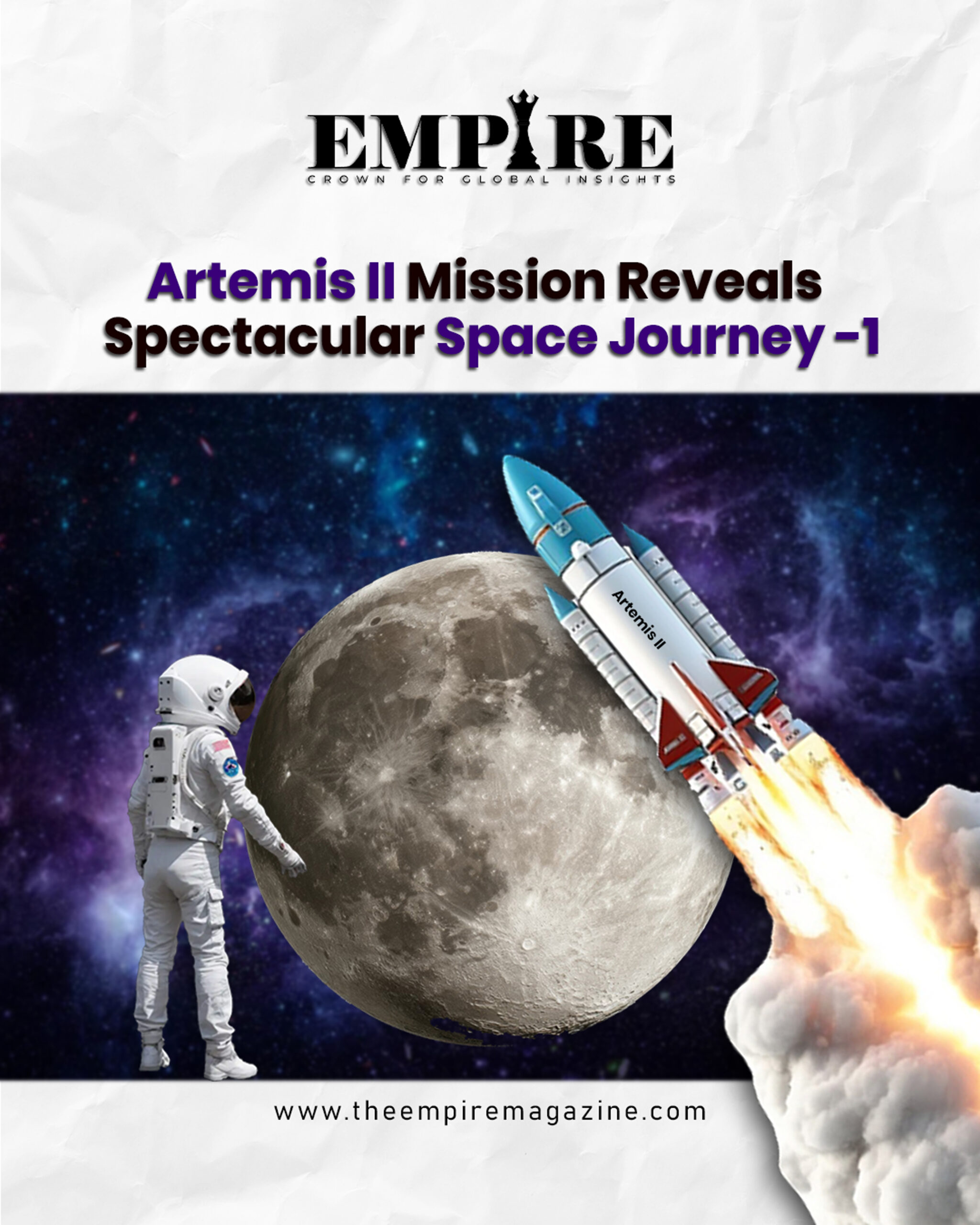
The Artemis II mission marks a groundbreaking step in human space exploration, as astronauts journey beyond Earth’s orbit and venture toward the far side of the Moon. This mission is not just about reaching new distances—it represents a powerful combination of technological innovation, human resilience, and the enduring desire to explore the unknown.
One of the most critical moments of the mission occurred when the Orion spacecraft successfully completed a major engine burn. This maneuver propelled the spacecraft out of Earth’s gravitational influence and set it on a precise path toward the Moon. The burn was executed at the spacecraft’s lowest orbital point relative to Earth, ensuring maximum efficiency and accuracy. The operation was described as flawless, demonstrating the reliability of modern spaceflight systems and marking a significant milestone for the mission.
A Historic Leap Beyond Earth’s Orbit
The Artemis II mission represents humanity’s return to deep space exploration after decades of limited crewed missions beyond low Earth orbit. By sending astronauts farther than most missions in recent history, this journey symbolizes a renewed commitment to exploring the cosmos.
Astronauts onboard the Orion spacecraft shared their first reactions after completing the critical engine burn. Their words reflected both excitement and pride, emphasizing humanity’s ability to push boundaries and achieve extraordinary goals. This moment was not just a technical success but also an emotional one, reminding the world of what collective human effort can accomplish.
Witnessing Earth from a New Perspective
One of the most awe-inspiring experiences for the crew has been observing Earth from deep space. Commander Reid Wiseman described the view as “spectacular,” noting that the entire planet was visible from pole to pole. This breathtaking perspective offered a rare glimpse of Earth as a single, unified entity.
From such a distance, the astronauts could see vast oceans, continents, and atmospheric patterns in their entirety. This view not only highlights the beauty of our planet but also its fragility. Seeing Earth from space often changes how astronauts perceive the world, reinforcing the importance of protecting the environment and fostering global unity.
Precision Engineering and Mission Success
The success of the Artemis II mission is rooted in precise engineering and advanced technology. Every component of the spacecraft has been carefully designed and tested to ensure safety and efficiency. From propulsion systems to navigation controls, each element plays a crucial role in the mission’s success.
The flawless execution of the engine burn is a testament to years of research, development, and rigorous testing. Engineers and mission specialists continue to monitor the spacecraft’s performance, ensuring that all systems are functioning as expected. The astronauts themselves are also actively involved in testing manual controls and operational procedures, providing valuable data for future missions.
Life Aboard the Orion Spacecraft
Living in space presents unique challenges and experiences. The Artemis II crew is adapting to microgravity, where everyday activities such as eating, sleeping, and moving require adjustment. Despite these challenges, the astronauts have demonstrated remarkable adaptability and teamwork.
Sleeping in space, for example, is vastly different from sleeping on Earth. Without gravity, astronauts float inside the spacecraft, secured in place to prevent drifting. These experiences not only highlight the human aspect of space exploration but also provide valuable insights into how humans can live and work in space for extended periods.
The crew’s ability to adapt to these conditions is essential for the success of future missions, especially those involving longer durations and greater distances.
A Mission Focused on Testing, Not Landing
Unlike earlier lunar missions, Artemis II is not designed for landing on the Moon. Instead, the Orion spacecraft will travel around the Moon and return to Earth. This approach allows mission planners to focus on testing critical systems and ensuring their reliability.
The journey around the Moon will take several days, during which the crew will conduct observations and gather data. This phase of the mission is crucial for validating the spacecraft’s capabilities and preparing for future missions that will include lunar landings.
By prioritizing safety and system validation, Artemis II serves as a stepping stone toward more ambitious exploration goals.
A Symbol of Global Unity and Progress
The Artemis II mission is not just a scientific achievement—it is also a symbol of unity and collaboration. Astronauts from different backgrounds are working together to achieve a shared goal, demonstrating the power of international cooperation.
This mission inspires people around the world, reminding us that exploration is a collective endeavor. It encourages future generations to pursue careers in science, technology, and space exploration, ensuring continued progress in these fields.
Pushing the Limits of Human Exploration
As the Orion spacecraft travels farther from Earth, it may set new records for human spaceflight distance. This achievement highlights the advancements made in space technology and the growing capabilities of modern spacecraft.
Each milestone reached during the mission brings humanity closer to future exploration goals, including establishing a sustainable presence on the Moon and eventually sending humans to Mars. Artemis II is a crucial step in this journey, laying the foundation for the next era of space exploration.
The Future of Space Exploration
The success of the Artemis II mission signals the beginning of a new chapter in space exploration. With each achievement, humanity moves closer to unlocking the mysteries of the universe and expanding its presence beyond Earth.
Future missions will build on the data and experience gained from Artemis II, enabling more complex and ambitious endeavors. These missions will not only advance scientific knowledge but also open new possibilities for innovation and discovery.
For more insights on global innovations and future-forward missions, visit:
👉 https://theempiremagazine.com/?p=5635&preview=true
Stay connected with us:
Instagram: https://www.instagram.com/the_empire_magazine/
Facebook: https://www.facebook.com/profile.php?id=61573749076160
– The Empire Magazine
Crown For Global Insights