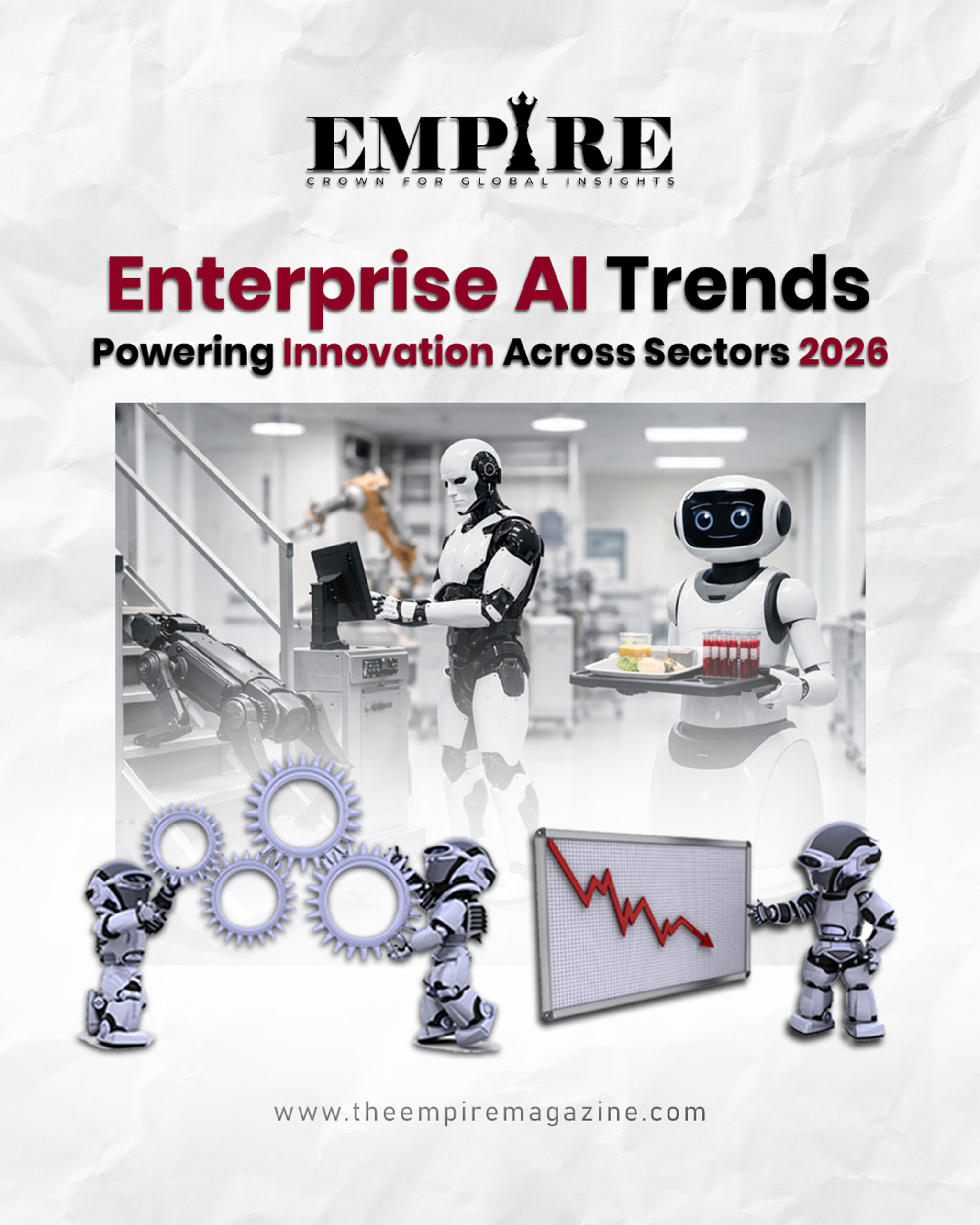
The rise of enterprise AI trends is redefining the way industries operate, compete, and grow. What once seemed like a futuristic concept has now become a practical and powerful force in modern business. From improving patient care in hospitals to optimizing inventory in retail, strengthening fraud detection in finance, and enhancing safety in construction, artificial intelligence is no longer just an experimental tool. It is becoming the foundation of enterprise transformation.
The most important shift in today’s business world is not simply the adoption of AI, but how organizations are embedding it into daily operations. Businesses are moving beyond basic automation and entering a new era of intelligent systems that can analyze, predict, personalize, and respond in real time. These enterprise AI trends are helping companies improve efficiency, reduce costs, make faster decisions, and deliver better experiences to customers.
As industries become more data-driven, the importance of AI continues to grow. The true value of enterprise AI lies in its ability to solve industry-specific challenges while also creating new opportunities for innovation and scalability. Let’s explore how enterprise AI trends are transforming different sectors and why they are becoming central to future business success.
AI in Healthcare: Smarter Care and Faster Decisions
One of the most impactful areas influenced by enterprise AI trends is healthcare. Artificial intelligence is changing how medical professionals diagnose illnesses, monitor patients, and improve treatment outcomes.
In diagnostics, AI systems can examine X-rays, MRIs, and other imaging data with remarkable speed and accuracy. This helps doctors identify conditions earlier and make more informed treatment decisions. AI also supports personalized treatment plans by analyzing patient history, symptoms, and response patterns.
Drug discovery is another major area where AI is making a difference. Instead of relying only on traditional, time-consuming research processes, AI can predict molecular interactions and identify promising drug candidates much faster. This shortens development cycles and supports more efficient innovation.
Remote patient monitoring has also become a strong use case. AI-powered wearables can track heart rate, oxygen levels, sleep patterns, and other health indicators in real time. When abnormalities are detected, healthcare professionals can respond quickly. These enterprise AI trends are making healthcare more proactive, personalized, and efficient.
AI in Gaming: Smarter, More Personalized Experiences
The gaming world is also being shaped by enterprise AI trends, especially in the areas of personalization, realism, and interaction. AI allows developers to create more dynamic and intelligent game environments that respond to player behavior.
Improved visualization is one major example. AI can enhance graphics, create more realistic environments, and improve how characters and worlds behave. This results in more immersive and visually rich gaming experiences.
Voice-based AI assistants are also transforming gameplay. Players can use voice commands to navigate menus, trigger features, or get support without interrupting the game flow. AI also enables more personalized experiences by adjusting challenges, environments, and interactions based on each player’s style. These enterprise AI trends are helping gaming become more adaptive and engaging than ever before.
AI in Retail and eCommerce: Precision and Personalization
Retail is one of the sectors where enterprise AI trends are creating visible and immediate impact. Retailers are using AI to optimize operations, improve customer experiences, and increase profitability.
Inventory management has become smarter through AI-powered forecasting. Businesses can now predict demand patterns, reduce stock shortages, and avoid overstocking. This improves operational efficiency and lowers waste.
Visual search is another innovation reshaping online shopping. Customers can search for products using images instead of text, making the shopping experience faster and more intuitive. AI also powers personalized marketing by studying browsing habits, purchase history, and preferences to recommend relevant products.
Checkout-free shopping systems represent another key development. By using computer vision, RFID, sensors, and AI analysis, retailers can allow customers to pick products and leave without a traditional checkout process. These enterprise AI trends are making shopping more seamless, efficient, and customer-friendly.
AI in Transportation: Safer and More Intelligent Mobility
In transportation, enterprise AI trends are enabling smarter mobility systems and safer travel experiences. AI is helping manage traffic, power autonomous vehicles, and optimize route planning.
Self-driving vehicles represent one of the most recognized AI use cases. These systems analyze road conditions, traffic signals, pedestrian movement, and obstacles to make driving decisions. While fully autonomous transport is still evolving, AI has already improved navigation, safety assistance, and route efficiency.
Traffic management is another powerful application. AI can study traffic flow patterns, sensor data, and live road conditions to reduce congestion and improve urban mobility. Digital number plate systems and smart transport infrastructure also rely on AI to provide instant alerts and real-time monitoring.
These enterprise AI trends are making transportation more connected, efficient, and responsive to changing conditions.
AI in Manufacturing: Efficiency, Quality, and Industry 5.0
Manufacturing is being rapidly transformed by enterprise AI trends, especially through predictive maintenance, supply chain optimization, and quality assurance.
Predictive maintenance helps companies monitor machines and detect failure risks before they lead to downtime. By analyzing sensor data and usage patterns, AI enables manufacturers to fix equipment at the right time instead of waiting for breakdowns.
Supply chain optimization is equally important. AI helps identify the most efficient routes, reduces delivery delays, and improves inventory planning across the manufacturing ecosystem. Computer vision also plays a major role in identifying defects and ensuring product quality in real time.
Industry 5.0, which emphasizes the collaboration between human creativity and intelligent systems, is also growing. These enterprise AI trends are allowing manufacturers to improve productivity while maintaining quality and reducing waste.
AI in Finance: Security, Speed, and Smarter Analysis
The financial sector is one of the earliest adopters of enterprise AI trends, using AI to improve risk assessment, fraud detection, and market analysis.
In credit evaluation, AI can examine customer financial history and behavior more accurately, helping institutions make better lending decisions. Fraud detection has become much stronger through machine learning models that identify suspicious transaction patterns in real time.
AI is also helping traders and investors analyze market signals, detect trends, and respond more quickly to volatility. In insurance, AI improves claims processing by evaluating images, detecting inconsistencies, and measuring claim risks more accurately.
These enterprise AI trends are helping finance organizations become more secure, data-driven, and efficient.
AI in Agriculture: Smarter Farming and Resource Management
Agriculture is another field where enterprise AI trends are creating practical value. AI helps farmers make informed decisions through precision farming tools, automation, and predictive insights.
Farmers can use AI to monitor weather conditions, crop health, and soil quality. This improves decisions around irrigation, fertilization, and harvest timing. Automated machinery such as AI-powered tractors and harvesters also improves efficiency while reducing labor pressure.
AI is also useful in pest and disease management. By identifying crop issues early, farmers can take action before damage spreads. These enterprise AI trends are helping agriculture become more productive, sustainable, and resilient.
AI in Education and Entertainment
In education, enterprise AI trends are improving both learning and administration. AI can personalize content according to a student’s learning speed and style, helping improve academic outcomes. It can also automate tasks such as grading and scheduling, allowing educators to focus more on teaching.
In entertainment, AI is being used to create content, recommend media, analyze audience behavior, and adjust delivery in real time. Whether it is generating music, improving streaming recommendations, or helping content creators understand viewer preferences, these enterprise AI trends are transforming how audiences interact with entertainment.
AI in Construction and Cybersecurity
Construction companies are benefiting from enterprise AI trends through project planning, safety monitoring, and predictive maintenance. AI can improve scheduling, optimize resource allocation, and identify safety risks through sensors and real-time surveillance.
In cybersecurity, AI is essential for detecting threats, monitoring suspicious behavior, and strengthening digital protection. Facial recognition, threat hunting, and intelligent surveillance systems are becoming increasingly valuable. Because cyber risks evolve quickly, these enterprise AI trends provide businesses with a faster and more proactive defense strategy.
For more insights on business innovation and technology, visit:
https://theempiremagazine.com/?p=5883
Stay connected with us:
Instagram: https://www.instagram.com/the_empire_magazine/
Facebook: https://www.facebook.com/profile.php?id=61573749076160
– The Empire Magazine
Crown For Global Insights