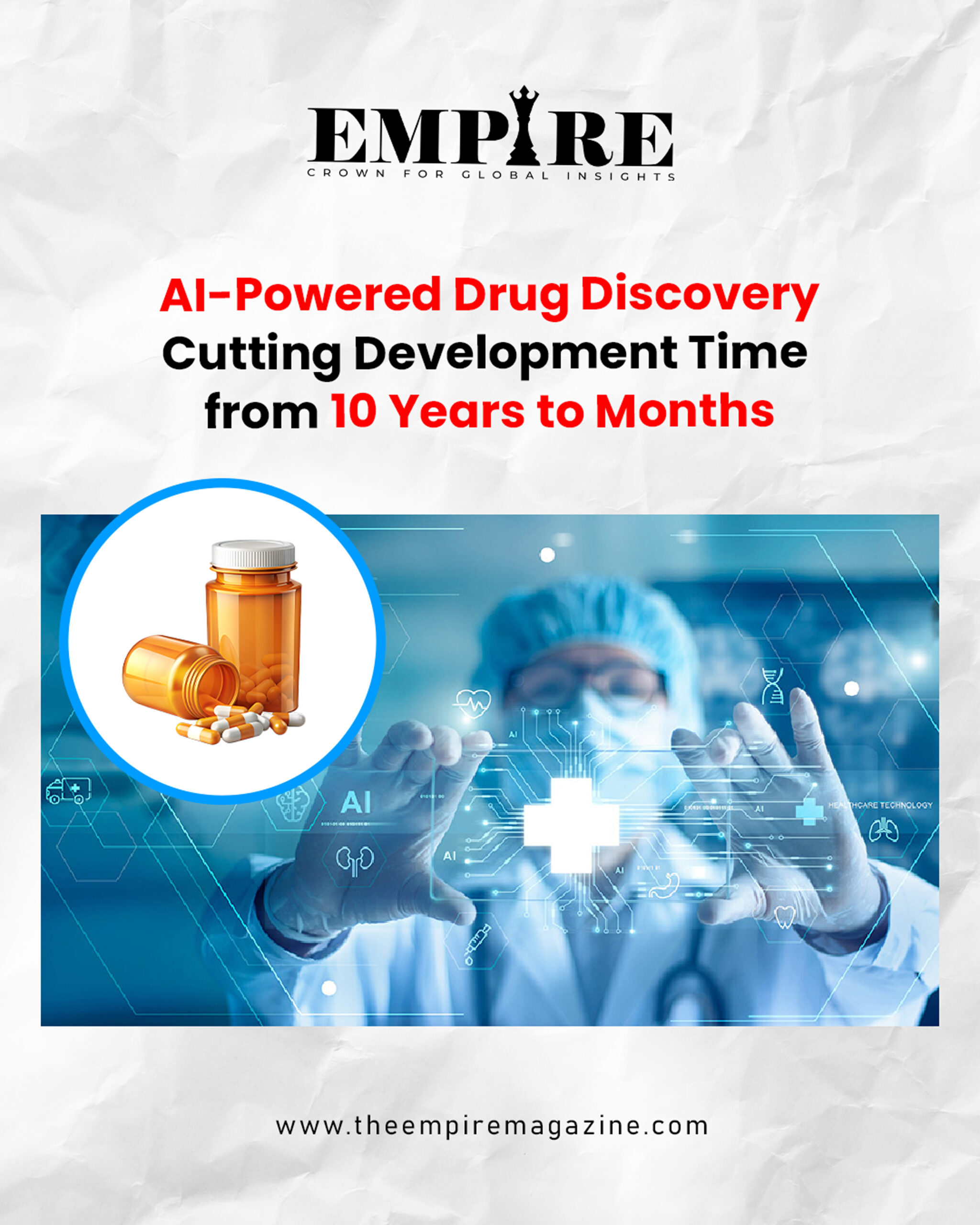
AI-Powered Drug Discovery is revolutionizing the pharmaceutical industry by dramatically reducing the time and cost of developing new medicines. What traditionally took 10–15 years and over $1–2 billion can now be shortened to just months or a few years using advanced artificial intelligence, offering new hope for faster treatments for cancer, rare diseases, and emerging health threats.
The Traditional Drug Discovery Process
Historically, drug discovery has been a long, expensive, and risky journey. It involves:
- Identifying disease targets
- Screening thousands of chemical compounds
- Preclinical testing on animals
- Multiple phases of human clinical trials
- Regulatory approvals
On average, only 1 out of every 10,000 compounds reaches the market. The entire process is plagued by high failure rates, especially in clinical trials, leading to massive financial losses for pharmaceutical companies.
How AI is Transforming Drug Discovery
AI-Powered Drug Discovery uses machine learning, deep learning, and generative AI to accelerate almost every stage of the process. Here’s how it works:
1. Target Identification AI can analyze vast biological datasets, including genomics, proteomics, and clinical records, to identify disease-causing targets with high precision in days instead of years.
2. Molecule Generation Generative AI models can design entirely new molecules with desired properties. Tools like AlphaFold (by DeepMind) have revolutionized protein structure prediction, making it easier to design drugs that bind perfectly to target proteins.
3. Virtual Screening Instead of physically testing thousands of compounds, AI simulates how molecules will interact with targets, filtering out weak candidates rapidly and reducing lab testing costs.
4. Predictive Toxicology & Safety AI models can predict potential side effects and toxicity early, significantly reducing failure rates in later clinical stages.
5. Clinical Trial Optimization AI helps in patient selection, trial design, and real-time monitoring, making clinical trials more efficient and personalized.
Major Breakthroughs in 2026
Several companies and research institutions are leading the AI drug discovery revolution:
- Insilico Medicine successfully used AI to discover a new drug for idiopathic pulmonary fibrosis and moved it into clinical trials in under 18 months.
- Exscientia and Recursion Pharmaceuticals have multiple AI-designed drugs in clinical phases.
- Google DeepMind’s AlphaFold continues to expand its impact, with new versions helping design drugs for previously “undruggable” targets.
- Indian companies like InSilico AI and collaborations between IITs and pharma giants are also making significant progress in AI-powered discovery for tropical and rare diseases.
In 2026, over 150 AI-designed drugs are in various stages of clinical trials globally — a number that was almost zero just five years ago.
Benefits of AI-Powered Drug Discovery
- Speed: Reduces discovery timeline from 10–15 years to 1–4 years in many cases.
- Cost Reduction: Can cut development costs by 50–70%.
- Higher Success Rate: Better prediction models improve the chances of clinical success.
- Personalized Medicine: Enables development of treatments tailored to genetic profiles.
- Rare Diseases: Makes it economically viable to develop drugs for smaller patient populations.
Challenges and Limitations
Despite impressive progress, AI-Powered Drug Discovery still faces hurdles:
- Data Quality: AI models need high-quality, diverse biological data, which is often limited.
- Regulatory Uncertainty: Regulatory bodies like the FDA and CDSCO are still evolving guidelines for AI-designed drugs.
- Black Box Problem: Understanding why AI makes certain predictions remains challenging.
- High Computational Costs: Training advanced models requires massive computing power.
- Ethical Concerns: Issues around data privacy, intellectual property, and potential biases in AI models.
The Road Ahead for 2026–2030
Experts predict that by 2030, nearly 30–50% of all new drugs could be discovered or optimized using AI. Pharmaceutical giants like Pfizer, Novartis, Sanofi, and Roche are heavily investing in AI partnerships.
In India, the government’s push through the National AI Mission and Biotechnology initiatives is expected to boost local capabilities in AI drug discovery, particularly for diseases like tuberculosis, diabetes, and cancer.
The combination of AI with quantum computing and advanced biotechnology (such as CRISPR) is expected to create even more powerful synergies in the coming years.
Conclusion
AI-Powered Drug Discovery is not just an incremental improvement — it is a paradigm shift that has the potential to save millions of lives by delivering new medicines faster and more affordably than ever before. While challenges remain, the momentum is undeniable.
As AI technology matures, we are moving closer to an era where life-saving drugs can be developed in months rather than decades, fundamentally changing healthcare for future generations.
For more insights on groundbreaking technologies in healthcare, read our detailed coverage here: AI-Powered Drug Discovery
Follow The Empire Magazine for more updates on HealthTech, AI, and future innovations:
– The Empire Magazine
Crown For Global Insights