
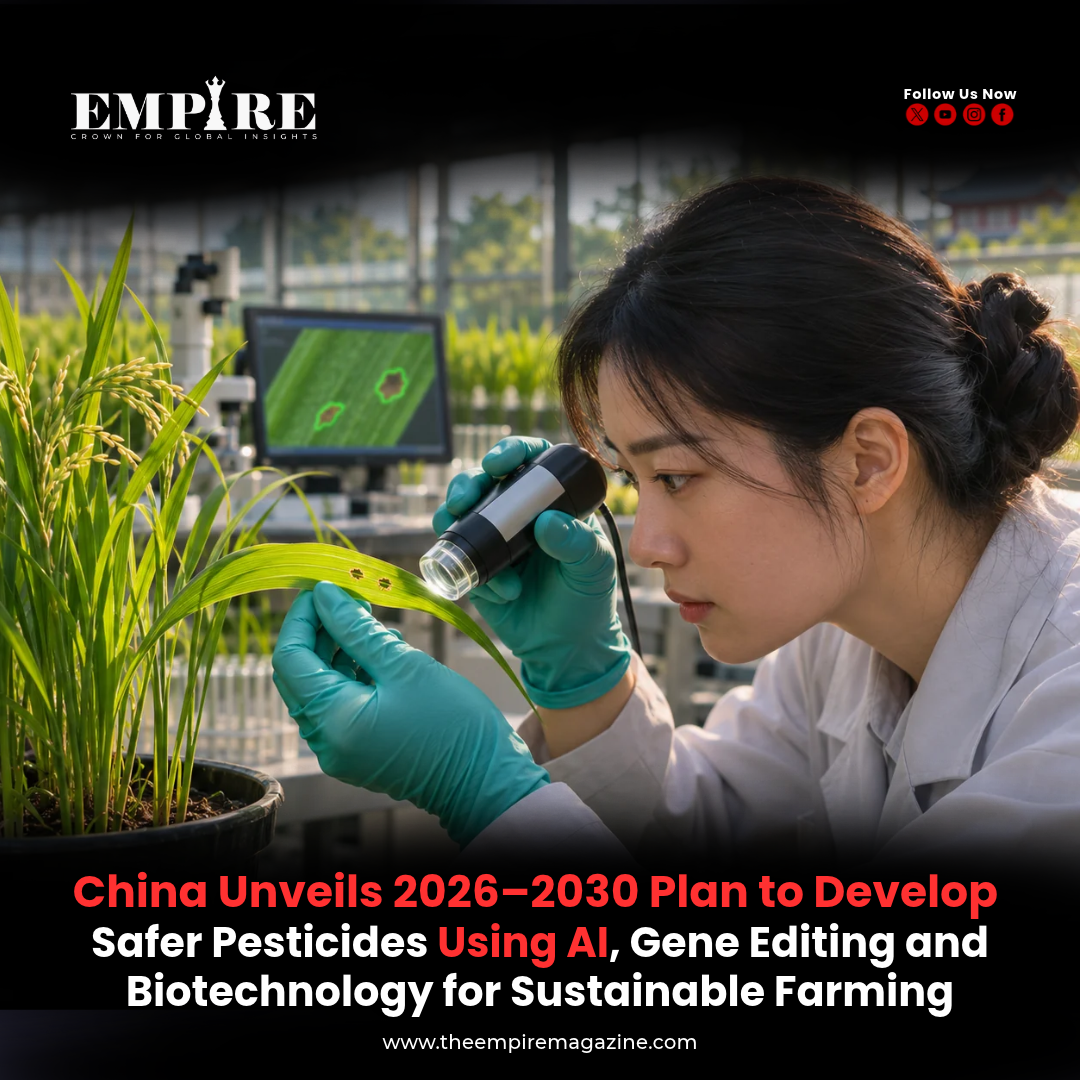
The strategy combines research into lower-risk products with cleaner manufacturing, stronger oversight and more precise pesticide use.
The China pesticide plan for 2026–2030 places artificial intelligence, gene editing and biotechnology among the tools intended to modernise crop protection. Its goals include developing effective products with lower risks, strengthening supply and improving how pesticides are manufactured, sold and used.
Formally titled the National Pesticide Industry Development Plan for the 15th Five-Year Plan period, the document is dated 19 October 2026. It was issued jointly by the agriculture, industry and environment ministries and the National Forestry and Grassland Administration.
The strategy sets a research and industrial policy direction. Achieving safer farming will depend on the performance of individual products, regulatory assessment and practical adoption in the field.
China Pesticide Plan Sets Priorities Through 2030
By the end of the planning period, authorities want a more reliable supply of pesticides, broadly stable production capacity and an improved range of available products.
The programme also seeks closer links between pesticide distribution and advice on appropriate use. That connects manufacturers and retailers with the practical decisions farmers make about protecting their crops.
Its priorities include innovation, resistance monitoring, cooperation between companies and research institutions, and improved regulatory services. Together, these measures address several stages of the industry, from discovery to use.
For businesses, this suggests that research capability, product quality and service provision will become increasingly important alongside manufacturing scale.
AI Moves Into Pesticide Discovery
AI-assisted design is a central research direction within the China pesticide plan.
In pesticide research, computational models can help assess candidate molecules and prioritise options for experimental testing. A study published in 2026 combined AI-based assessment with compound development and biological testing, illustrating one possible approach.
This offers a potential way to narrow the search for useful compounds before committing to extensive development work. The commercial value would come from making better research decisions and directing laboratory resources toward stronger candidates.
However, a computational prediction is one stage in development. Researchers still need evidence about biological activity, crop performance and environmental behaviour.
Biotechnology Expands the Research Options
The China pesticide plan also identifies gene editing, RNA interference and biosynthesis as research tools, while encouraging biological pesticide development.
These approaches have different functions. Gene editing changes genetic material, while RNA interference can suppress the expression of selected genes without editing DNA. The distinction matters when evaluating how a product works and what evidence is needed to assess it.
Biopesticides are also a broad category. They can include microorganisms and naturally occurring substances used to control pests. The US Environmental Protection Agency distinguishes microbial, biochemical and plant-incorporated forms in its classification.
For Chinese developers, the opportunity is to expand the range of available pest-control approaches. Each candidate will still require evidence suited to its characteristics and intended use.
Safety and Resistance Need Measurable Progress
Reducing risk is an important objective of the China pesticide plan, which calls for reassessing registered products and replacing inefficient, higher-risk options.
Safety assessment involves more than the method used to discover a pesticide. Relevant considerations include exposure, environmental persistence and effects on organisms beyond the intended pest. OECD guidance on externally applied RNA pesticides highlights the need to assess potential effects on non-target organisms.
Resistance management is another part of the challenge. A product that initially performs well can become less effective as pest populations develop resistance.
The Food and Agriculture Organization links resistance problems with the need for integrated pest management. Its approach combines suitable biological, physical, chemical and crop-management measures to protect crops while reducing unnecessary pesticide use and associated risks.
Precision Use Connects Innovation With Farmers
The China pesticide plan encourages more precise application and stronger professional services for pest management.
This builds on a separate agriculture ministry initiative announced in March 2026. That programme promoted intelligent monitoring, efficient application equipment, biological control, stronger guidance and improved pesticide-use data.
These measures can help connect product development with decisions made on individual farms. A useful product needs to reach the appropriate crop and pest under conditions where it can perform effectively.
Farmer training and accessible advice therefore matter alongside equipment. Differences in farm size, local pest pressures and access to technical support will influence how readily new approaches can be adopted.
Manufacturing and Sales Face Closer Attention
The China pesticide plan also addresses industrial production. It supports cleaner technology, digital upgrades and controls on poorly planned capacity expansion.
The emphasis on broadly stable overall capacity indicates a focus on improving the industry’s structure and product mix. Improving efficiency and developing distinctive products are therefore important parts of the industrial strategy.
The document also calls for stronger oversight of online pesticide sales and clearer responsibilities for platforms and sellers.
For manufacturers and distributors, these priorities increase the importance of reliable product information, regulatory compliance and effective customer guidance. Improvements in discovery will have greater practical value when supported by dependable production and distribution.
Opportunities for Agricultural Technology Businesses
The China pesticide plan encourages companies, universities and research institutes to work together on pesticide innovation.
Such cooperation could help connect specialist research with formulation development, testing and commercial production. Potential opportunities extend to computational research tools, biological products, application services and monitoring systems.
Turning these opportunities into viable businesses will depend on useful performance, production economics and the ability to meet registration requirements.
For farmers, the practical test will be whether new products and services provide dependable crop protection at an affordable cost. A technically advanced approach must also work within ordinary farm operations.
Delivery Will Determine the Outcome
The China pesticide plan provides a framework for modernising an industry closely connected to food production and environmental protection.
Progress should be assessed through evidence: effective new products, appropriate regulatory decisions, stronger resistance monitoring, improved application practices and measurable reductions in risk.
AI and biotechnology can contribute to those goals. Their ultimate value will depend on how research, manufacturing, regulation and farmer support work together throughout the 2026–2030 period.
Explore more global business, technology and innovation coverage in The Empire Magazine’s article archive.
Read our related coverage: bhp-copper-expansion-south-australia/
Follow The Empire Magazine:
Facebook | Instagram
The Empire Magazine | Crown For Global Insights