
United States | Business, Energy & Technology
Information checked on 2 October 2026.
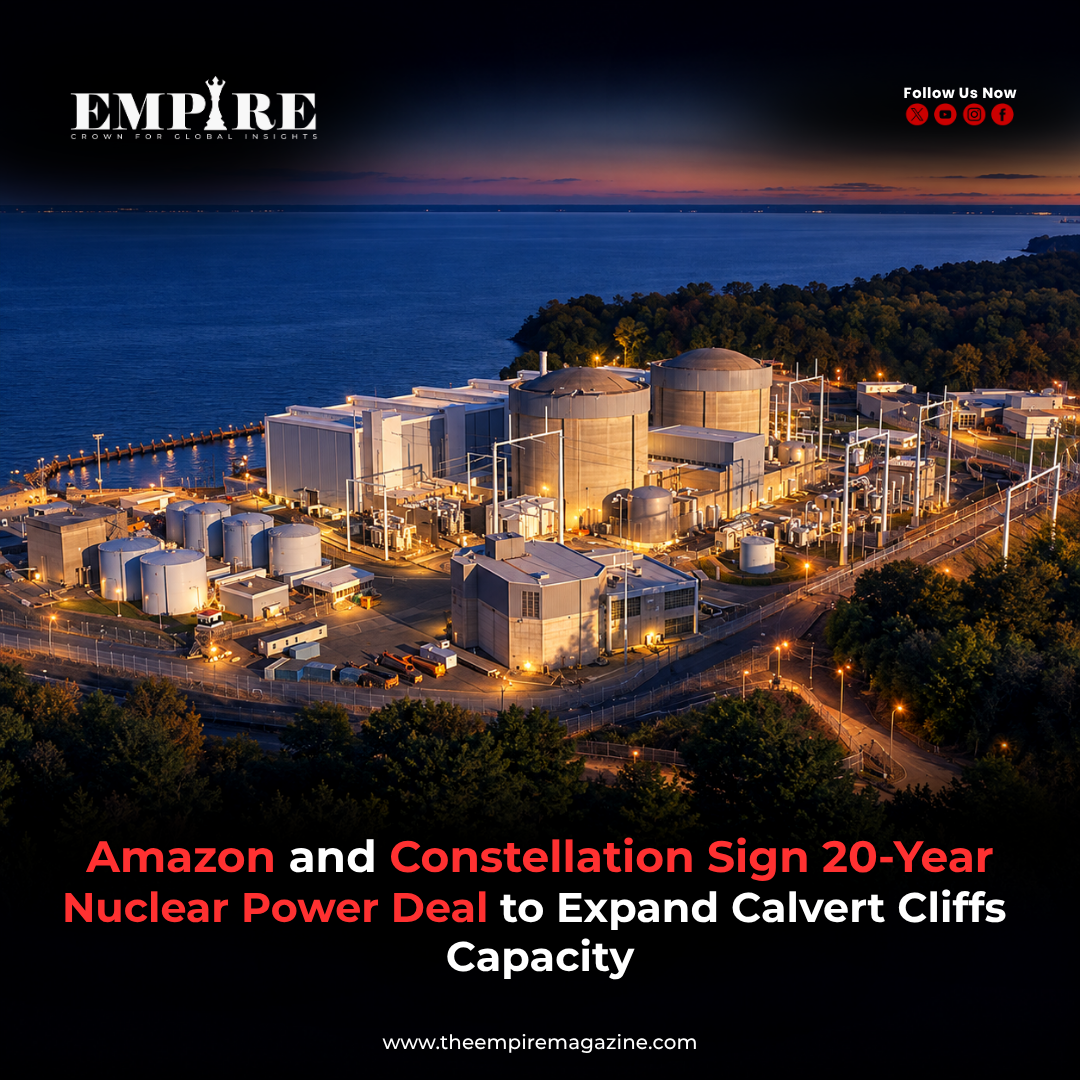
Amazon and Constellation announced a 20-year power purchase agreement on 30 September 2026 to support expanded generation at the Calvert Cliffs Clean Energy Center in Lusby, Maryland.
The agreement connects Amazon’s long-term electricity procurement with investment in an existing nuclear facility. From a business perspective, it highlights a practical challenge facing the technology sector: securing dependable power requires commitments that extend well beyond the construction cycle of an individual data centre.
What the 20-Year Agreement Covers
Constellation’s announcement sets out the following figures:
| Agreement detail | Announced scope |
|---|---|
| Contract duration | 20 years |
| Power covered by the agreement | 690 megawatts (MW) |
| Planned additional generating capacity | Approximately 190 MW |
| Current plant capacity | 1,790 MW |
| Expected timing of additional capacity | Between 2030 and 2032 |
| Infrastructure investment enabled | More than $3 billion, covering plant improvements and expansion |
The 690 MW contract includes the proposed 190 MW increase. Based on those figures, approximately 500 MW of the contracted amount relates to existing capacity.
The announcement therefore combines support for existing generation with investment in additional output. The full contracted amount should not be interpreted as newly created generating capacity.
How Calvert Cliffs Would Generate More Electricity
The planned expansion involves a power uprate, a process that increases the permitted output of an existing nuclear reactor.
The US Nuclear Regulatory Commission explains that reactor licences establish a maximum thermal power level. An operator seeking to increase that level must obtain regulatory permission and demonstrate that the proposed configuration can operate safely.
Depending on the design, an uprate can require modifications to equipment that handles additional heat, steam and electricity. Components such as turbines, pumps, generators and transformers may need upgrading or replacement. These are general features of the uprate process; the precise work depends on the individual plant and proposal.
For Calvert Cliffs, regulatory filings and engineering updates will provide a clearer account of the work required. The announced delivery window is a project expectation whose achievement will depend on the progress of that work.
Why the Electricity Will Remain on the PJM Grid
Amazon says electricity from Calvert Cliffs will continue flowing into PJM, the regional grid serving all or parts of 13 states and the District of Columbia. A related retail supply agreement will support Amazon’s operations within that region.
This structure matters when considering the agreement’s wider effects. Amazon is making a long-term purchasing commitment, while the power station remains part of a shared electricity system. The announcement does not describe an exclusive power line supplying a single Amazon facility.
Maryland’s electricity figures help explain the regional context. According to the US Energy Information Administration, the state generated approximately 35.4 million megawatt-hours of electricity in 2024, while retail electricity sales reached approximately 59.0 million megawatt-hours. Nuclear power was its primary generation source.
Those figures show that in-state generation was smaller than retail sales. They also underline why developments at a major generating station matter beyond the company purchasing its output. The difference between the two measures should not, however, be treated as an exact calculation of electricity imports.
Why AI and Data Centre Demand Matter
The agreement comes as electricity planners reassess the scale and timing of demand from data centres and other large users.
In its January 2026 long-term forecast, PJM projected average annual growth of approximately 3.6% in summer peak demand over the following decade. Peak demand measures the system’s highest expected electricity requirement, rather than total annual consumption.
PJM also lowered its near-term projections through 2032 compared with its previous forecast. The revision reflected more detailed assessment of proposed large loads, alongside changes in economic and electric-vehicle assumptions.
Together, these findings show both the scale of expected growth and the uncertainty surrounding its timing. A proposed data centre does not automatically become an operating facility, and electricity forecasts change as project information improves.
For companies planning computing infrastructure, this creates a coordination problem. Buildings, servers, transmission connections and new generation must become available on compatible schedules. Long-term procurement can support that planning, but a signed contract alone cannot resolve every physical constraint on the grid.
What the $3 Billion Investment Figure Means
The announced $3 billion-plus figure concerns infrastructure investment enabled by the agreement. It should not be presented as the disclosed purchase price of Amazon’s electricity contract.
Maryland Matters reported that the financial specifics of the power agreement remain confidential. Without those details, the public announcement cannot establish Amazon’s electricity price or the project’s expected financial return.
From a business perspective, the attraction of a long-term agreement is easier to understand. A generator can plan major expenditure with greater visibility over future contracted sales. A large electricity buyer can incorporate a defined supply arrangement into its infrastructure planning.
The benefits to other electricity customers require a separate assessment. Additional generation can contribute to supply, but household bills also reflect network costs, market conditions and regulatory decisions. The agreement itself does not establish a specific reduction in residential electricity prices.
Longer Operation Remains a Separate Licensing Question
Constellation says the commercial commitment supports its pursuit of another 20 years of operating life for Calvert Cliffs.
NRC reactor records list the current operating licence expiration dates as:
| Reactor | Current licence expiration |
|---|---|
| Calvert Cliffs Unit 1 | 31 July 2034 |
| Calvert Cliffs Unit 2 | 13 August 2036 |
These are the current dates recorded by the regulator.
Increasing output and extending operating life address different questions. An uprate concerns how much power a reactor may produce; licence renewal concerns how long it may continue operating.
The purchasing agreement supplies commercial support for the company’s plans. It does not itself grant a licence extension or replace the relevant regulatory decisions.
The Status of Amazon’s Earlier Local Data Centre Proposal
The power agreement follows a separate development involving Amazon in Calvert County.
On 4 August 2026, the county government announced that Amazon Data Services had withdrawn its Calvert Technology Center Conceptual Site Development Plan and decided not to pursue the proposed local data centre. The application had been submitted in May.
The September power agreement should therefore be understood on its announced terms: electricity procurement and support for generating investment. It does not, by itself, establish that the withdrawn data centre proposal has returned.
What Comes Next at Calvert Cliffs
Amazon also says the companies are exploring the potential for further nuclear development at the site. That exploratory work represents a possible longer-term opportunity, rather than an announced commitment to construct a new reactor.
For the capacity increase already outlined, the most useful next disclosures will concern regulatory progress, the equipment programme, investment commitments and commissioning milestones. These will help show whether the proposed expansion remains on course.
The agreement gives Calvert Cliffs a major customer commitment around which to plan. Its practical contribution to future electricity supply will become clearer as the plant’s proposed improvements move from commercial agreement to completed engineering work.
Explore more global business, technology and innovation coverage in The Empire Magazine’s article archive.
Follow The Empire Magazine for global business, technology, innovation and leadership insights: microsoft-quine-ai-experimental-biology-research/
Facebook: The Empire Magazine
Instagram: @the_empire_magazine
The Empire Magazine | Crown For Global Insights