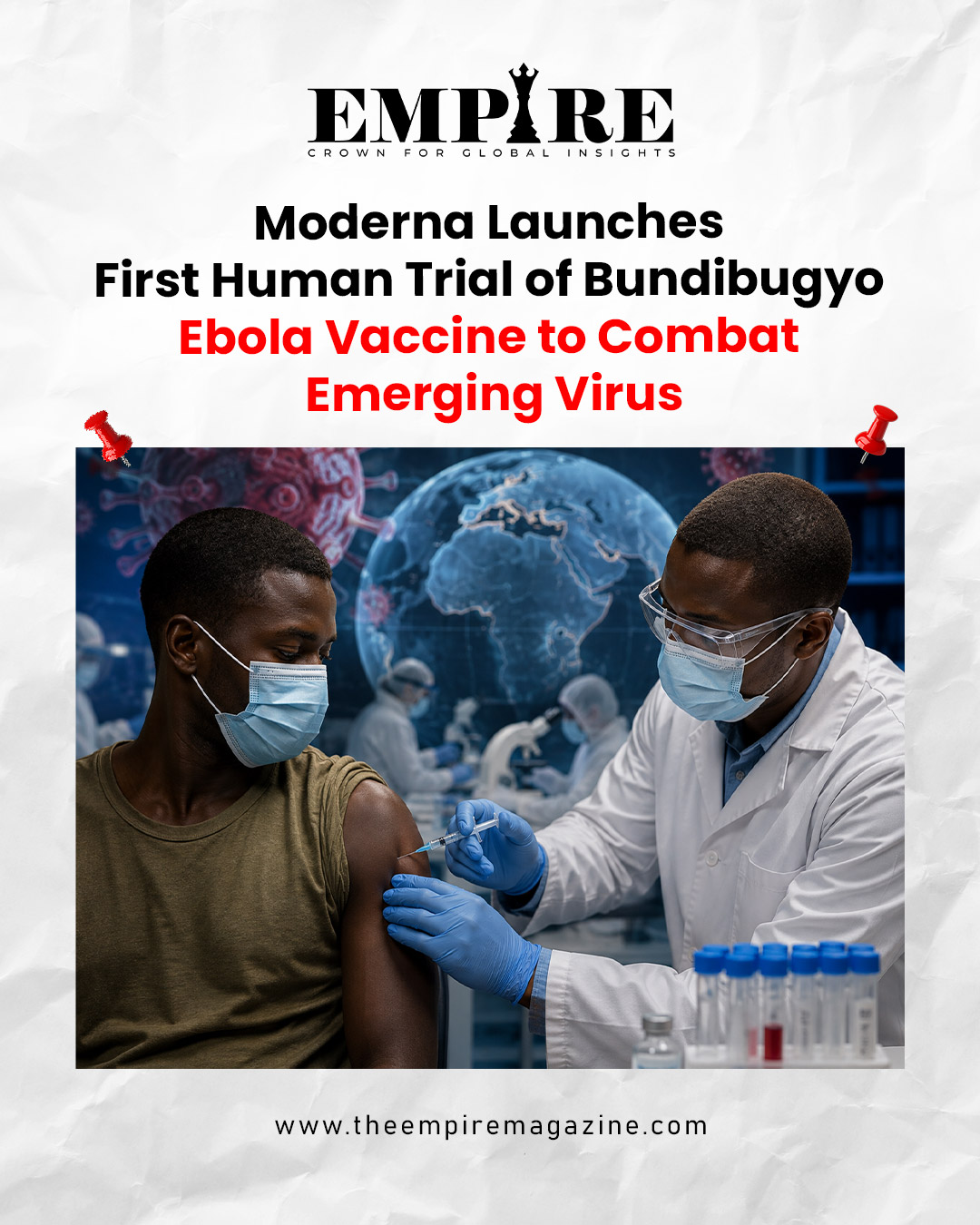
Moderna begins a Phase 1 human trial of its Bundibugyo Ebola vaccine, mRNA-1469, offering new hope against a deadly virus with no approved vaccine. Moderna has begun a Phase 1 human trial of its experimental Bundibugyo Ebola vaccine, mRNA-1469, in Canada. The trial will evaluate safety, tolerability and immune response in about 80 healthy adults, marking an important step toward developing a vaccine for a strain with no approved vaccine.
Moderna Bundibugyo Ebola Vaccine Trial Begins
Moderna has entered a new chapter in infectious disease research with the launch of a Phase 1 human trial for its experimental Bundibugyo Ebola vaccine, mRNA-1469. The first participants have already been vaccinated in Canada after Health Canada authorized the study, making the development an important milestone in the global response to the growing Bundibugyo virus outbreak. The trial is being conducted at three Canadian sites and is expected to involve approximately 80 healthy adults. Researchers will primarily examine whether the vaccine is safe, tolerable and capable of generating an immune response. The development comes at a critical moment because Bundibugyo ebolavirus remains a major public health concern and, unlike the Zaire strain of Ebola, currently has no approved vaccine specifically indicated for protection against it. Moderna’s candidate uses the company’s established mRNA platform, the same broad technology that transformed vaccine development during the COVID-19 pandemic. However, the new Ebola vaccine remains experimental, and the Phase 1 study is only the beginning of a much longer clinical and regulatory process.
Why the Bundibugyo Ebola Vaccine Matters
The significance of the Bundibugyo Ebola vaccine becomes clearer when viewed against the scale of the current outbreak. The Democratic Republic of the Congo has been battling sustained transmission of Bundibugyo virus, with the outbreak expanding across multiple health zones. WHO reported 2,124 confirmed cases and 828 deaths in the DRC as of July 15, with transmission still active in dozens of affected health zones. The outbreak was serious enough for WHO to declare the situation a Public Health Emergency of International Concern in May 2026. Uganda, which also reported cases linked to transmission from the DRC, has since made significant progress and entered its 42-day countdown toward declaring its outbreak over after the last confirmed patient was discharged. The continuing situation in the DRC nevertheless highlights a difficult reality: medical teams are fighting a dangerous disease while scientists work to develop tools specifically suited to the virus responsible. Existing Ebola vaccines are primarily designed for the Zaire ebolavirus, meaning a dedicated Bundibugyo Ebola vaccine could address a significant gap in outbreak preparedness.
How Moderna’s Bundibugyo Ebola mRNA-1469 Vaccine Works
At the heart of Moderna’s Bundibugyo Ebola vaccine is mRNA technology, a platform that became globally recognized during the COVID-19 pandemic. Instead of introducing a weakened or inactivated virus, an mRNA vaccine provides cells with temporary instructions to produce a specific viral protein, allowing the immune system to recognize the target and build a defensive response. Moderna is now applying that platform to Bundibugyo ebolavirus through its experimental candidate mRNA-1469. The approach is particularly interesting for emerging infectious diseases because mRNA platforms can potentially be adapted more rapidly than some traditional vaccine technologies. That speed can become valuable when outbreaks evolve faster than conventional research timelines. Still, technological speed does not remove the need for rigorous testing. Scientists must establish safety, determine the strength and durability of the immune response, and ultimately demonstrate whether vaccination protects people from disease. Moderna’s Phase 1 study therefore represents a scientific starting point rather than a finished solution. Its importance lies in moving a previously unapproved vaccine concept into human testing and generating the clinical evidence needed for the next stage of development.
The Growing Need for an Ebola Vaccine
The current outbreak has placed renewed attention on the need for vaccines that can protect against different Ebola virus species. Bundibugyo ebolavirus is distinct from the Zaire ebolavirus targeted by established vaccines, creating a gap that has become increasingly visible during the 2026 outbreak. WHO has reviewed whether licensed Ebola vaccines could provide some cross-protection during Bundibugyo outbreaks, but the agency has also emphasized the need to assess available evidence carefully. At the same time, researchers are pursuing several vaccine approaches. Oxford University launched a Phase 1 trial in July for its ChAdOx1 BDBV candidate, which uses the same chimpanzee adenovirus platform associated with the Oxford-AstraZeneca COVID-19 vaccine. The Oxford trial involves 50 healthy adults and became the first human clinical trial of a vaccine specifically targeting Bundibugyo ebolavirus. Moderna’s subsequent entry into human testing therefore adds another technological approach to the growing global vaccine effort. Multiple candidates can be valuable because no single scientific platform is guaranteed to succeed, particularly against a virus that has historically received less vaccine-development attention than more widespread pathogens.
What the Human Trial Will Test for Moderna Bundibugyo Ebola vaccine
The Moderna Bundibugyo Ebola vaccine is entering human testing through a carefully controlled Phase 1 study. Approximately 80 healthy adults across three Canadian sites are expected to participate, with researchers evaluating the candidate’s safety, tolerability and immunogenicity. In simple terms, scientists want to understand how people respond to the vaccine and whether it produces the desired immune reaction without unacceptable safety concerns. Phase 1 trials generally do not provide the final evidence needed to determine whether a vaccine prevents disease in real-world outbreak conditions. Instead, they establish the foundation for larger studies. If the results support continued development, Moderna and its partners could move toward later-stage trials involving more participants and more detailed assessments of effectiveness. The speed of this process will matter because vaccine development is occurring alongside an active outbreak, but scientific urgency must remain balanced with clinical standards. The first volunteers receiving mRNA-1469 is therefore an important milestone, not a declaration that a finished Ebola vaccine is ready for public use. The candidate will need to clear multiple scientific and regulatory hurdles before it can potentially become an approved product.
Moderna and CEPI Join Forces
The development of the Bundibugyo Ebola vaccine also demonstrates how public-health organizations and biotechnology companies can work together when commercial incentives alone may not be enough. Moderna is advancing mRNA-1469 through an expanded collaboration with the Coalition for Epidemic Preparedness Innovations, or CEPI. Under the partnership, CEPI has committed up to $50 million to support preclinical development and the Phase 1 clinical trial, while the collaboration also supports the scaled manufacture of additional clinical-trial doses. This partnership is significant because rare or emerging infectious diseases can struggle to attract the same level of investment as large commercial vaccine markets. By supporting research before an outbreak becomes even larger, organizations such as CEPI aim to reduce the time between scientific discovery and practical pandemic preparedness. Moderna has also committed, if the vaccine is eventually licensed, to making at least 500,000 doses available to low- and middle-income countries under access pricing. That commitment places affordability and availability alongside scientific innovation, two factors that can determine whether a successful vaccine actually reaches communities facing the greatest risk.
The Road Ahead for the Ebola Vaccine
The road from a Phase 1 trial to an approved Bundibugyo Ebola vaccine remains long. Moderna will first need to understand the safety profile and immune response generated by mRNA-1469. Positive Phase 1 findings could support progression into larger Phase 2 and Phase 3 studies, where researchers would examine the vaccine in broader populations and gather stronger evidence about effectiveness and safety. The challenge is that Ebola outbreaks can change rapidly, sometimes making conventional efficacy trials difficult to conduct. This has already shaped the global response to the current Bundibugyo outbreak, with WHO and partners evaluating different vaccine candidates and therapeutics while also strengthening surveillance and outbreak-control measures. Oxford’s candidate and Moderna’s mRNA vaccine are therefore part of a wider scientific race rather than competing solutions in isolation. The ultimate objective is not simply to produce a vaccine but to create a reliable tool that can be manufactured, deployed and accepted quickly when Bundibugyo virus appears again. If mRNA-1469 continues to perform well, its development could also demonstrate how flexible mRNA technology can be when applied beyond respiratory viruses and into neglected or emerging infectious diseases.
A New Chapter in Global Health through Moderna’s Bundibugyo Ebola vaccine
Moderna’s Bundibugyo Ebola vaccine trial represents more than another pharmaceutical development. It reflects how the lessons of one global health crisis can influence preparedness for the next. The COVID-19 pandemic demonstrated the potential of mRNA technology to move from laboratory research to mass vaccination at unprecedented speed. The challenge now is whether that same platform can be adapted successfully to a very different and deadly pathogen such as Bundibugyo ebolavirus. For communities affected by the current outbreak, the arrival of another vaccine candidate offers a measure of hope, but it must be matched with strong healthcare systems, surveillance, community engagement, testing and rapid treatment. Vaccines are one part of outbreak control, not the entire answer. Moderna’s entry into human testing nevertheless marks a meaningful step toward closing a long-standing gap in Ebola preparedness. If mRNA-1469 proves safe and effective through the clinical development process, it could eventually become an important addition to the global response against Bundibugyo virus and strengthen the world’s ability to respond before future outbreaks grow into larger crises.
For more business and retail insights, read more on The Empire Magazine
Previous article: https://theempiremagazine.com/swaminathan-award/
Magazine Feautures | Podcasts: Empire Global Talks
Follow The Empire Magazine on Facebook | Instagram | LinkedIn | YouTube
The Empire Magazine | Crown for Global Insights