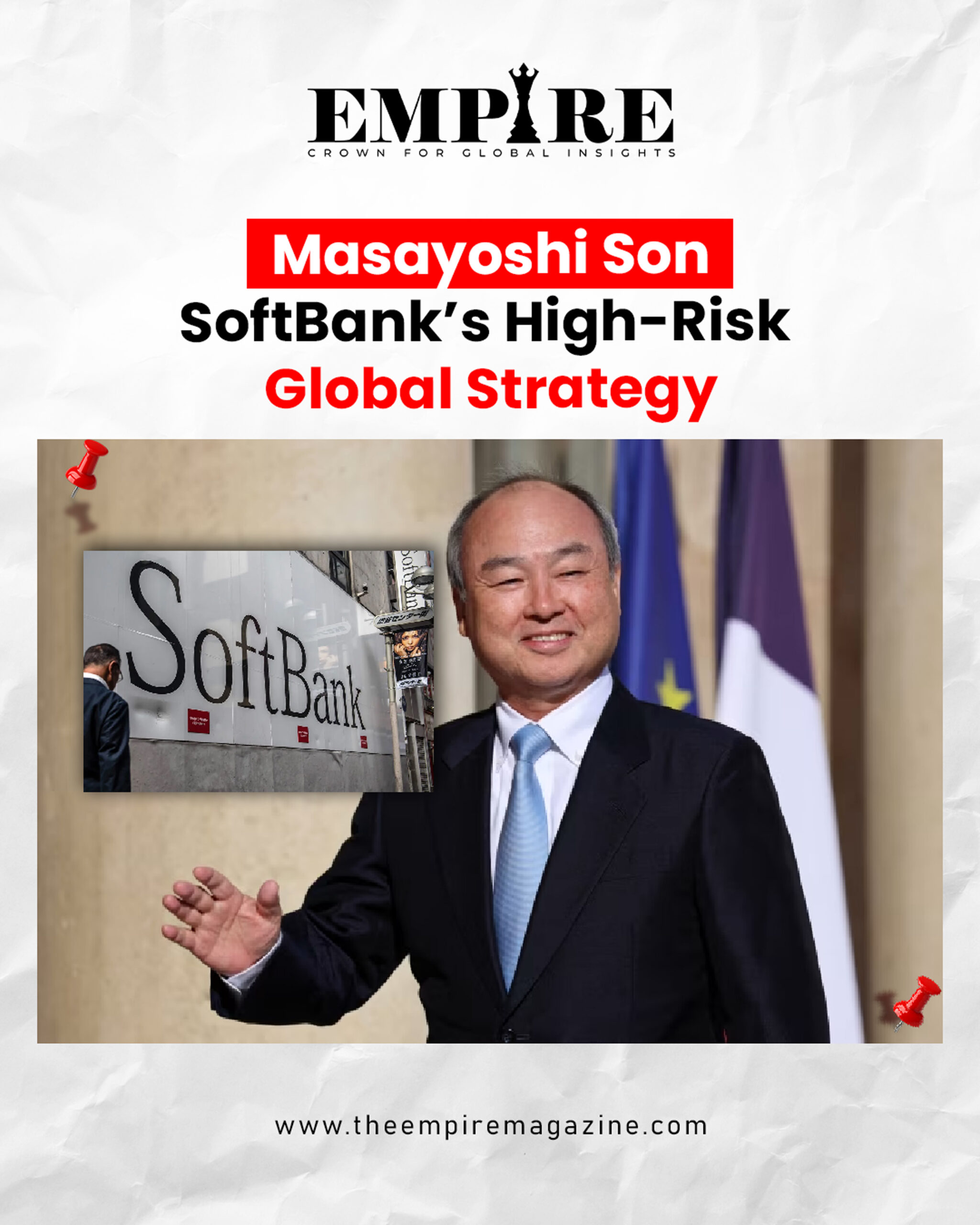
Masayoshi Son is one of the most influential technology investors in the world and the founder, chairman, and chief executive officer of SoftBank Group. His investment strategy has always been linked to big technology cycles, bold capital allocation, and high-risk bets on companies that could shape the future of computing, communications, e-commerce, mobility, artificial intelligence, and digital infrastructure.
SoftBank began as a software distribution business in Japan in 1981 and later expanded into telecom, internet investments, mobile services, semiconductor assets, venture capital, and global technology platforms. Under Masayoshi Son’s leadership, the company became known for making large and sometimes controversial bets on future-defining companies.
His strategy has created major wins, major losses, and repeated reinventions. SoftBank’s investment history includes early backing of Alibaba, the acquisition of Arm, the creation of the Vision Fund, large investments in technology startups, and a new focus on artificial intelligence infrastructure and OpenAI.
The Alibaba Investment That Defined SoftBank’s Reputation
One of Masayoshi Son’s most famous investments was Alibaba. SoftBank invested in Alibaba in 2000, when the Chinese e-commerce company was still young. That investment later became one of the most successful technology bets in history.
SoftBank became Alibaba’s largest shareholder and benefited massively as Alibaba grew into one of China’s largest internet companies. The Alibaba investment helped define Son’s reputation as an investor willing to back companies before the rest of the market fully understood their potential.
A Long-Term Internet Bet
The Alibaba deal reflected Son’s belief that internet platforms could become the foundation of future commerce. At the time, e-commerce was still developing in China, but Son saw the long-term opportunity in online marketplaces and digital business.
This success gave SoftBank more capital, credibility, and confidence to make larger technology investments globally.
The Vision Fund and the Era of Giant Startup Bets
In 2017, SoftBank launched the Vision Fund, one of the largest technology investment funds ever created. The fund was backed by SoftBank, Saudi Arabia’s Public Investment Fund, Mubadala, Apple, Qualcomm, Foxconn, Sharp, and other investors.
The Vision Fund invested in companies across ride-hailing, food delivery, logistics, fintech, robotics, real estate technology, healthcare, artificial intelligence, and enterprise software. Its portfolio included companies such as Uber, DoorDash, Coupang, Grab, WeWork, Didi, and many others.
Investing at Unusual Scale
The Vision Fund changed startup investing because it deployed very large amounts of capital into private companies. Startups that previously raised hundreds of millions could suddenly receive billions. This allowed companies to expand quickly, enter new markets, subsidize growth, and build large teams.
However, this strategy also created risks. Some companies grew faster than their business models could support. WeWork became the most famous example of SoftBank’s investment problems after its failed 2019 IPO attempt and later bankruptcy.
Losses, Retrenchment, and Portfolio Pressure
SoftBank’s high-risk strategy produced major losses during periods of market correction. In 2022 and 2023, rising interest rates, falling technology valuations, and startup market weakness hurt the Vision Fund portfolio.
Reuters reported that SoftBank booked heavy Vision Fund losses as technology bets declined in value. The company reduced risk, sold assets, slowed new investments, and focused more heavily on balance sheet discipline. SoftBank also sold down large parts of its Alibaba stake to raise capital.
Why the Vision Fund Became Controversial
The Vision Fund became controversial because it showed both the power and danger of large-scale venture investing. Large checks helped some companies dominate markets, but they also encouraged aggressive expansion and high cash burn.
For investors, SoftBank became a symbol of high-risk technology capital. For founders, it offered the possibility of rapid global expansion. For critics, it showed how too much money could distort startup discipline.
Arm and the Semiconductor Future
SoftBank acquired Arm Holdings in 2016 for about $32 billion. Arm is a British semiconductor design company whose chip architecture is used in smartphones, data centers, automobiles, Internet of Things devices, and increasingly AI-related computing.
SoftBank listed Arm on Nasdaq in September 2023. Reuters reported that SoftBank raised about $5 billion from the Arm listing, and the later rise in Arm’s share price strengthened SoftBank’s asset base.
Why Arm Matters to SoftBank’s AI Strategy
Arm is important because artificial intelligence depends on efficient computing. Arm-based designs are widely used in power-efficient processors, and the company is increasingly connected to AI infrastructure, edge computing, cloud servers, and data center chips.
For Masayoshi Son, Arm represents a strategic asset in the AI era. It gives SoftBank exposure to the semiconductor layer behind artificial intelligence, not only AI software and applications.
Masayoshi Son’s Return to AI Investing
After years of retrenchment, Masayoshi Son returned aggressively to AI investment. Reuters reported in 2025 that SoftBank was aiming to become a leading artificial superintelligence platform provider, with Son’s latest spending spree following earlier years of Vision Fund losses and caution.
SoftBank’s 2025 report also states that the group became the largest shareholder of Alibaba, launched the SoftBank Vision Funds to invest in AI-driven companies, and acquired Arm to accelerate its growth.
Artificial Superintelligence as a Strategic Theme
Son has long spoken about artificial intelligence as a transformative force. His current strategy focuses on artificial superintelligence, which refers to AI systems that could exceed human intelligence in many areas.
SoftBank’s AI push now includes OpenAI, Arm, data centers, energy infrastructure, robotics, and AI-related investment platforms. This shows a shift from investing mainly in consumer internet startups to building the infrastructure layer of the AI economy.
OpenAI and SoftBank’s Largest AI Bet
SoftBank has made one of its biggest recent commitments to OpenAI, the company behind ChatGPT. Reuters reported that SoftBank completed a $40 billion investment in OpenAI in December 2025, marking one of the largest private funding rounds ever and deepening Son’s bet on artificial intelligence.
Reuters also reported that SoftBank secured a $40 billion bridge loan in March 2026 to support further OpenAI investment and general corporate needs. The loan reflected SoftBank’s deepening commitment to AI and came after earlier commitments linked to OpenAI and the Stargate infrastructure project.
Why OpenAI Fits Son’s Strategy
OpenAI fits Son’s strategy because it sits at the center of the generative AI boom. ChatGPT helped bring AI into mainstream business and consumer use. OpenAI also needs massive infrastructure investment to train and operate advanced models.
SoftBank’s investment is not only a software bet. It is also connected to cloud computing, data centers, chips, power, and AI services.
Stargate, Data Centers, and AI Infrastructure
AI infrastructure has become a major part of SoftBank’s strategy. Reuters reported that SoftBank’s investments include the U.S.-based Stargate initiative, which aims to support hundreds of billions of dollars in AI infrastructure.
In 2026, Reuters reported that SoftBank planned to invest €45 billion over five years to build AI data centers in France, delivering 3.1 gigawatts of capacity in the Hauts-de-France region. The investment was described as one of the biggest AI infrastructure projects in Europe.
Energy and Data Centers as AI Foundations
Modern AI requires huge computing power. Data centers need chips, servers, cooling systems, networking equipment, and electricity. This is why SoftBank is investing not only in AI companies but also in energy and infrastructure.
Reuters reported that SoftBank hired banks for planned U.S. IPOs of SB Energy and Roze, an AI robotics spinoff. SB Energy is linked to renewable energy and data center infrastructure, while Roze focuses on autonomous construction technology for AI infrastructure development.
High-Risk Strategy and Financial Leverage
Masayoshi Son’s strategy has always involved high risk. SoftBank uses asset sales, debt, equity holdings, margin loans, and large portfolio bets to fund new opportunities. This approach can create major upside when markets rise, but it can also create pressure when valuations fall.
Reuters reported in 2025 that SoftBank was working to fulfill a $22.5 billion OpenAI funding commitment by selling assets, using loans, and pausing many Vision Fund investments. The report also said any Vision Fund deal above $50 million required Son’s direct approval during that period.
Concentration Risk
SoftBank’s current AI strategy creates concentration risk because major value is tied to AI-related assets such as OpenAI and Arm. Reuters reported that analysts have raised concerns about SoftBank’s OpenAI-related debt and compared the concentration risk with earlier lessons from WeWork.
This is the central pattern of Son’s career: large concentrated bets can create extraordinary gains, but they can also expose SoftBank to sharp losses.
Why Investors Still Watch Masayoshi Son
Investors watch Masayoshi Son because his strategy often signals where large technology capital may move next. His past bets have shaped internet commerce, telecom, venture investing, mobile platforms, chip design, and now AI infrastructure.
SoftBank’s share price has also become closely tied to the AI market. Reuters reported in May 2026 that SoftBank posted a $12 billion fourth-quarter profit as gains from OpenAI helped lift results.
SoftBank as an AI Holding Company
SoftBank is increasingly seen as an AI-focused investment holding company. Its most important assets are connected to AI models, semiconductor architecture, data centers, energy infrastructure, and robotics.
This structure is different from a traditional telecom company or venture fund. It places SoftBank at the center of the AI capital cycle.
The Business Lesson Behind SoftBank’s Strategy
Masayoshi Son’s investment strategy shows how global technology investing can create both wealth and volatility. His approach is based on identifying large technology waves early and investing at a scale that can influence markets.
This strategy worked powerfully with Alibaba. It became risky with WeWork and other high-growth startups. It is now being tested again with OpenAI, Arm, AI data centers, and artificial superintelligence.
For more global investment and technology insights, read this feature on The Empire Magazine.
Follow The Empire Magazine on Instagram and Facebook.
– The Empire Magazine
Crown For Global Insights