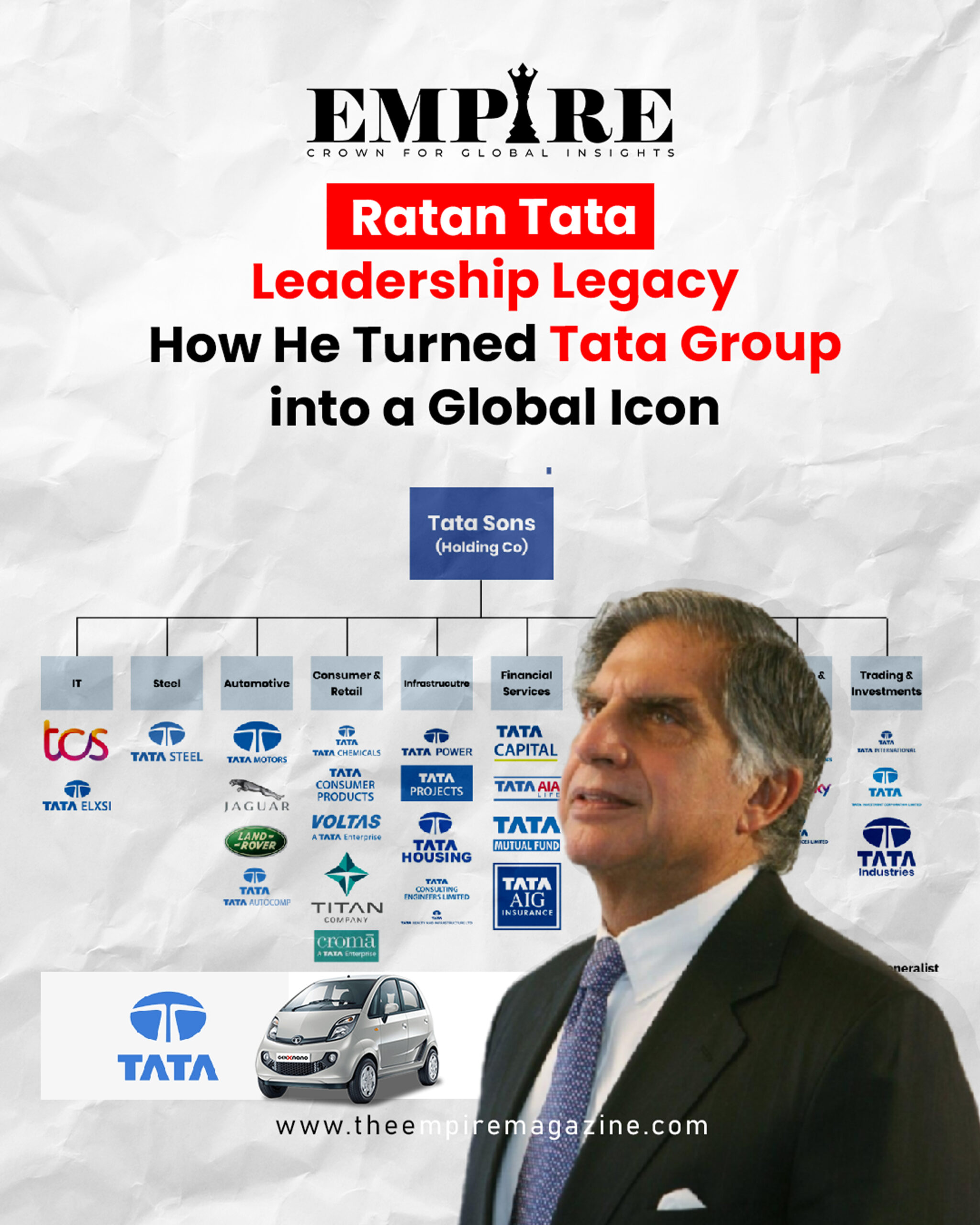
Ratan Tata leadership legacy stands as one of the most inspiring chapters in modern Indian business history. Under his visionary guidance, the Tata Group transformed from a respected but largely India-centric conglomerate into a global powerhouse with operations in over 100 countries. His tenure as Chairman from 1991 to 2012 is widely regarded as the defining era that elevated the Tata brand to international prominence while preserving its core values of ethics, compassion, and excellence.
Early Life and Entry into the Tata Group
Born on December 28, 1937, into the illustrious Tata family, Ratan Naval Tata was raised with a strong sense of responsibility and humility. He studied architecture at Cornell University and later attended the Harvard Business School Advanced Management Program.
Despite his privileged background, Ratan Tata began his career on the shop floor at Tata Steel in Jamshedpur in 1962, working alongside blue-collar workers. This hands-on experience shaped his deep understanding of operations and empathy for employees. He steadily rose through the ranks, handling various businesses before being appointed Chairman of the Tata Group in 1991, succeeding J.R.D. Tata.
The Turning Point: Taking Charge in 1991
When Ratan Tata assumed leadership, the Tata Group consisted of dozens of independent companies with varying levels of performance. The Indian economy was opening up after the 1991 liberalization, presenting both opportunities and intense competition from global players.
Ratan Tata faced significant internal resistance as he pushed for bold changes. He introduced the Tata Brand Equity scheme to unify the group under a single identity and implemented a retirement policy to bring fresh talent. His courageous decision to exit unprofitable or non-core businesses demonstrated strategic clarity and discipline.
Global Expansion and Iconic Acquisitions
The hallmark of Ratan Tata Leadership Legacy was his aggressive yet calculated global expansion strategy. Some of the most defining moves include:
- Tata Motors’ Acquisition of Jaguar Land Rover (2008): This landmark $2.3 billion deal turned heads worldwide. Many doubted the Indian company’s ability to manage British luxury brands, but under Ratan Tata’s stewardship, Jaguar Land Rover not only survived but thrived, becoming a major profit driver.
- Tata Steel’s Acquisition of Corus (2007): The $12 billion acquisition made Tata Steel one of the largest steel producers globally.
- TCS Growth: He played a key role in scaling Tata Consultancy Services into a global IT services giant, eventually taking it public in 2004.
- Tata Tea’s Acquisition of Tetley (2000): This marked one of the earliest major Indian acquisitions abroad and opened the door for future global forays.
By the time he retired in 2012, the Tata Group’s revenue had grown from $4 billion to over $100 billion, with more than 60% coming from international operations.
Leadership Style and Core Values
Ratan Tata was known for his quiet, dignified, and values-driven leadership. Key elements of his style included:
- Ethical Business Practices: He maintained zero tolerance for corruption even during aggressive expansion.
- Employee-Centric Approach: Famous for his concern for employees, he famously supported the family of every Tata employee who lost their life in the 26/11 Mumbai attacks.
- Innovation Focus: He championed the Tata Nano project, aiming to make cars affordable for the common Indian family.
- Courage in Decision Making: He took calculated risks that many considered too bold at the time.
- Long-term Vision: He always prioritized sustainable growth over short-term profits.
Philanthropy and Social Commitment
A defining part of the Ratan Tata Leadership Legacy is his unwavering commitment to social good. The Tata Trusts, which hold a majority stake in Tata Sons, continue to be one of India’s largest philanthropic organizations, focusing on healthcare, education, rural development, and disaster relief.
Ratan Tata personally championed several social initiatives and believed that businesses have a moral responsibility to contribute to society.
Life After Retirement and Enduring Influence
After stepping down as Chairman in 2012, Ratan Tata continued as Chairman Emeritus and played an active role as a mentor and investor through his personal office. He passionately supported startups in India, investing in numerous promising ventures in technology, e-commerce, and sustainability.
Even after his passing in October 2024, his principles continue to guide the Tata Group. Under the leadership of N. Chandrasekaran, the group has maintained its global stature while expanding into new sectors such as semiconductors, aviation, and digital services.
Lessons from Ratan Tata’s Leadership
Ratan Tata’s journey offers powerful lessons for leaders worldwide:
- Integrity and values can coexist with aggressive global ambition.
- Bold decisions, even when unpopular, can create extraordinary outcomes.
- True leadership lies in uplifting people and society, not just building balance sheets.
- Humility combined with courage creates lasting impact.
- Long-term thinking beats short-term opportunism.
Conclusion
The Ratan Tata Leadership Legacy is not merely about financial success or global acquisitions. It is about redefining what an Indian multinational could achieve while staying true to its founding principles. He proved that a company could be both fiercely competitive and deeply ethical, both globally respected and locally rooted.
From a family business rooted in India to a global icon spanning automobiles, steel, IT, hospitality, and more, Ratan Tata’s vision created a lasting blueprint for ethical capitalism in the 21st century. His life remains an inspiration for generations of entrepreneurs and leaders who seek to build institutions that outlast them.
For more inspiring stories of leadership, innovation, and global business, read our detailed coverage here.
Follow The Empire Magazine for more updates on business, startups, technology, and global insights: Instagram | Facebook
– The Empire Magazine
Crown For Global Insights