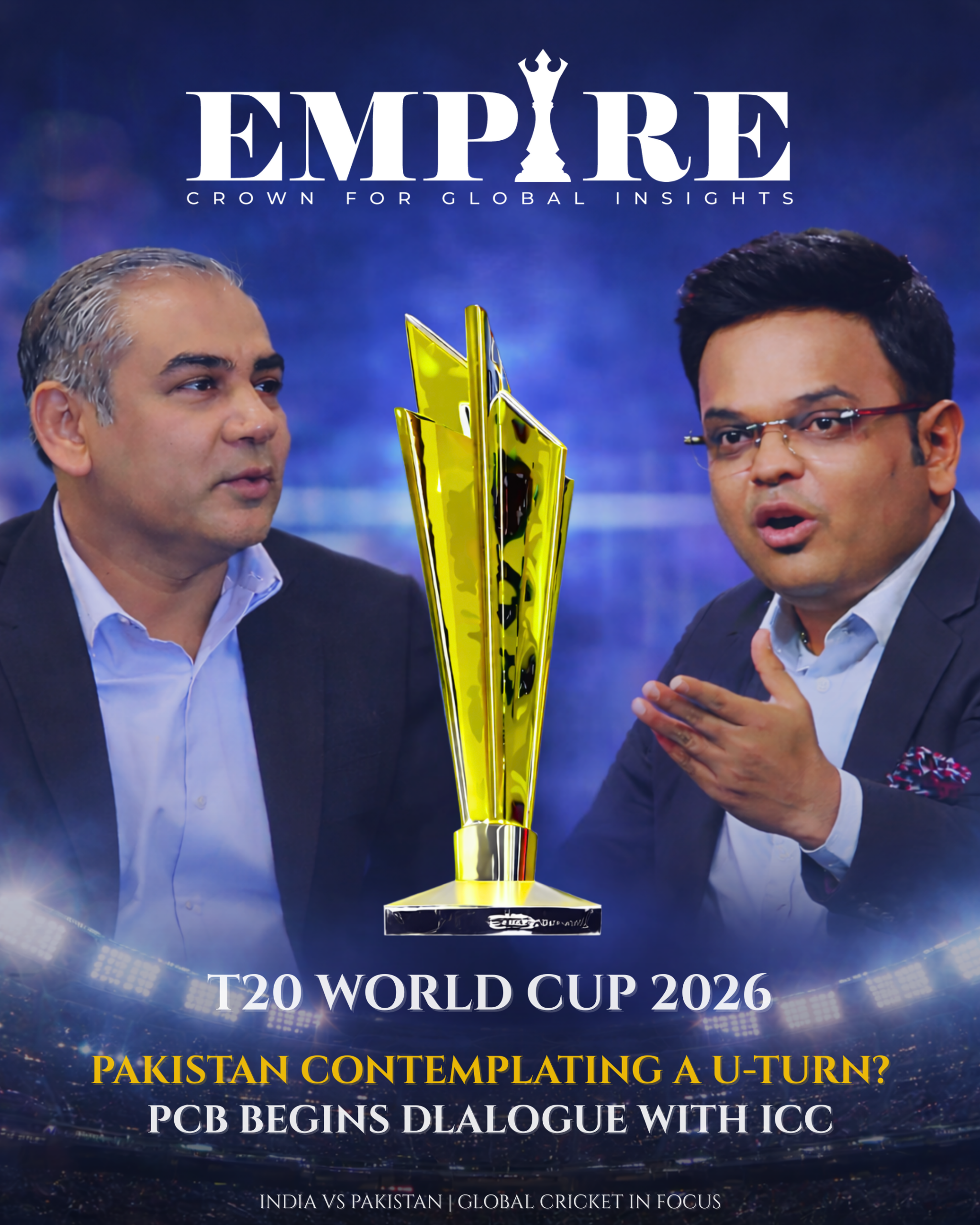
The T20 World Cup 2026 has become the center of renewed diplomatic and sporting discussions after indications that Pakistan may be reconsidering its earlier stance on participation and hosting-related arrangements. The development follows confirmation that the Pakistan Cricket Board (PCB) has initiated formal dialogue with the International Cricket Council, signaling a possible U-turn amid growing regional and logistical complexities.
With the tournament scheduled to be jointly hosted by India and Sri Lanka, Pakistan’s position has drawn significant attention, given recent history involving neutral venues, security concerns, and bilateral cricket relations.
Background: Why the T20 World Cup 2026 Is Sensitive for Pakistan
The T20 World Cup 2026 is not just another ICC event—it sits at the intersection of sport, politics, and diplomacy in South Asian cricket. Pakistan’s participation has been under scrutiny due to ongoing tensions with India and unresolved questions around travel, security, and reciprocal hosting arrangements.
In previous ICC tournaments, including the Asia Cup and ODI World Cup cycles, hybrid or neutral-venue models were adopted to ensure participation without direct travel between the two nations. These precedents shaped early speculation that Pakistan might push for similar concessions for the T20 World Cup 2026.
PCB Begins Talks With ICC: What Has Changed?
Recent reports suggest that the PCB has softened its public stance and opened direct discussions with the ICC to explore workable solutions. While no official reversal has been announced, the willingness to engage indicates that Pakistan is reassessing its options.
Several factors are believed to be driving this shift:
- The commercial importance of the T20 World Cup 2026
- Pressure from broadcasters and sponsors
- Player concerns about missing a major global event
- ICC’s preference for a unified tournament structure
For Pakistan, complete non-participation would carry significant financial and sporting consequences, making dialogue a pragmatic step.
Financial and Sporting Stakes of the T20 World Cup 2026
From a cricketing perspective, the T20 World Cup 2026 represents a critical opportunity for Pakistan’s next generation of players. T20 cricket remains Pakistan’s strongest format, and absence from the tournament could disrupt long-term team planning and rankings.
Financially, ICC events generate substantial revenue through broadcast rights, sponsorships, and prize money. Missing out would not only affect PCB revenues but could also weaken Pakistan’s negotiating position in future ICC cycles.
These realities appear to be influencing the PCB’s current approach, encouraging compromise over confrontation.
Hybrid Model or Full Participation?
One of the central questions in the ongoing discussions is whether a hybrid model will again be considered for the T20 World Cup 2026. Under such an arrangement, Pakistan’s matches could be played at a neutral venue, similar to previous solutions.
However, the ICC is reportedly keen to avoid complex logistics unless absolutely necessary. Tournament integrity, scheduling efficiency, and fan engagement are key considerations, and a fully integrated event remains the preferred outcome.
Pakistan’s dialogue with the ICC suggests that multiple options are on the table, including conditional participation frameworks.
India, Sri Lanka, and the ICC’s Position
As co-hosts, India and Sri Lanka are working closely with the ICC to ensure smooth tournament execution. The ICC has consistently emphasized that decisions must prioritize the global game, fairness, and commercial stability.
While the ICC has not publicly commented on Pakistan’s internal deliberations, its openness to dialogue reflects an effort to keep all major cricketing nations aligned ahead of the T20 World Cup 2026.
A consensus-driven solution would help prevent disruptions similar to those seen in previous multi-nation events.
What a U-Turn Would Mean for Pakistan Cricket
If Pakistan ultimately agrees to participate under revised terms, it would mark a strategic U-turn—one that prioritizes long-term cricketing interests over short-term political positioning.
Such a move could:
- Preserve Pakistan’s presence in global ICC events
- Strengthen PCB–ICC relations
- Reduce uncertainty for players and fans
- Reinforce Pakistan’s role in international cricket
At the same time, the PCB would likely seek assurances on future hosting rights and reciprocal arrangements to justify any compromise domestically.
Uncertainty Remains Ahead of the T20 World Cup 2026
Despite the ongoing dialogue, no final decision has been announced. Much will depend on the outcome of PCB–ICC negotiations, security assessments, and internal consensus within Pakistan’s cricket establishment.
As preparations for the T20 World Cup 2026 gather pace, clarity will be essential—not just for Pakistan, but for teams, broadcasters, sponsors, and fans worldwide.
A Defining Moment for the T20 World Cup 2026
The situation underscores how global cricket events increasingly extend beyond sport alone. The T20 World Cup 2026 now stands as a test of diplomacy, governance, and flexibility within international cricket.
Whether Pakistan completes its U-turn or holds firm, the decisions taken in the coming months will shape not only this tournament but also the future handling of sensitive bilateral issues within the ICC framework.
The Empire Magazine
Crown for Global Insights